

Govt vs Private Medical Colleges 2026: The Ultimate Guide
Admission & Info Tools
Need Expert Assistance?
Our counselors can help you with fee structures, eligibility guidelines, and upcoming admission cutoffs instantly.
Direct Application Tools
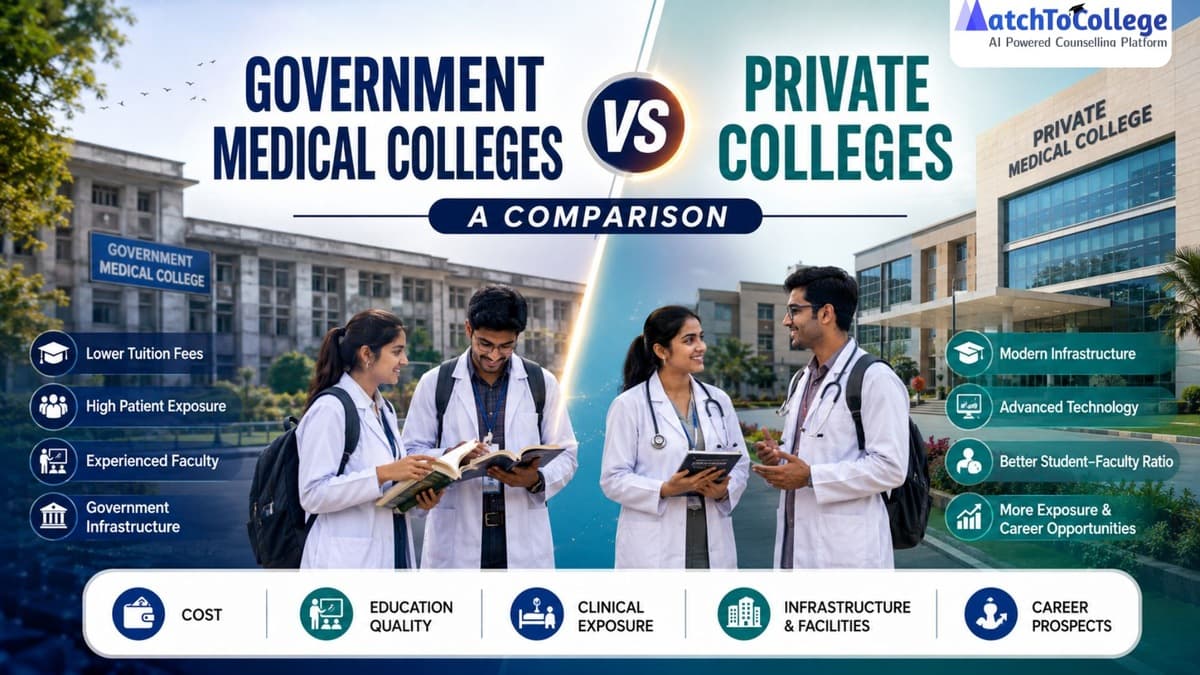
Government vs Private Medical Colleges
Choosing between a government and a private medical college is one of the most pivotal decisions aspiring doctors face in India. As we look towards the 2026 admission cycle, understanding the nuances, advantages, and disadvantages of both pathways is crucial for students and parents alike. This comprehensive guide from MatchToCollege aims to provide a clear, concise, and 100% accurate comparison, empowering you to make an informed choice that aligns with your academic aspirations, financial capabilities, and career goals.
The landscape of medical education in India is dynamic, with increasing competition for coveted MBBS seats. Government medical colleges have long been perceived as the gold standard, offering highly subsidized education and excellent clinical exposure. Private medical colleges, on the other hand, have invested heavily in state-of-the-art infrastructure and modern teaching methodologies, albeit with a significantly higher fee structure. For 2026, the key factors to consider remain consistent: academic quality, infrastructure, faculty expertise, clinical training, and most importantly, the financial implications.
Preparing for NEET 2026 and subsequent counseling requires a strategic approach. Our detailed comparison will delve into critical aspects such as fee structures, admission cutoffs, quality of education, research opportunities, patient load, and post-graduation prospects. By the end of this guide, you'll have a holistic view, helping you weigh your options meticulously. Remember, your journey to becoming a successful medical professional begins with the right foundation. Let's explore which path – government or private – might be the best fit for your medical dreams in 2026.
Cost & Affordability: Fees & Scholarships for MBBS 2026
The financial aspect is often the primary differentiator. Government medical colleges are heavily subsidized, making MBBS education remarkably affordable. Private colleges, however, operate on a self-financing model, leading to significantly higher fees.
Comparison Table: Estimated Annual Fees
| Factor | Government Medical Colleges | Private Medical Colleges |
| Annual Tuition Fee | ₹10,000 - ₹1,00,000 | ₹5,00,000 - ₹25,00,000+ |
| Hostel & Mess | ₹30,000 - ₹80,000 | ₹80,000 - ₹2,50,000+ |
| Scholarships | Limited, primarily merit-based or state-specific | Variable, institutional scholarships, merit-cum-means |
| Overall Cost (5.5 years) | ₹2 Lakhs - ₹8 Lakhs | ₹30 Lakhs - ₹1.5 Crores+ |
While government colleges offer a clear financial advantage, some private institutions provide scholarships or offer management/NRI quota seats which come at a premium but might be an option for those who don't meet the merit cut-offs for general seats. Prospective students should research specific college fee structures and potential financial aid well in advance for the 2026 cycle.
Infrastructure & Facilities: Campus Life & Modern Amenities
Both types of institutions boast impressive infrastructure, but there can be subtle differences. Government colleges often have long-standing, established campuses with vast libraries and well-equipped labs, though some older facilities might require modernization. Private colleges, particularly newer ones, frequently feature cutting-edge infrastructure, modern classrooms, advanced simulation labs, and comfortable hostel facilities built to contemporary standards.
- Government Colleges: Often have larger campuses, expansive hospitals with high patient footfall (excellent for clinical exposure), and extensive libraries. Some might have older buildings, but are continually upgrading.
- Private Colleges: Tend to invest heavily in modern lecture halls, advanced research laboratories, digital libraries, and often provide more luxurious hostel and recreational facilities. Their attached hospitals may be newer with specialized departments.
Academic Quality & Faculty: Learning Environment & Research
The quality of education is paramount. Government medical colleges, especially the AIIMS network, consistently rank among the top institutions, attracting highly experienced and renowned faculty. Their focus on research is significant, with many faculty members engaged in national and international studies.
- Government Colleges: Faculty often includes senior professors with decades of experience, leading researchers, and practitioners. The academic environment is rigorous, fostering a strong emphasis on foundational knowledge and critical thinking.
- Private Colleges: Many private institutions also boast excellent faculty, often drawing talent from both government and private sectors. They sometimes offer more innovative teaching methodologies and a greater emphasis on hands-on practical training with newer technologies. Research opportunities are growing in top private colleges.
Admission Process & Competition: NEET & Cutoff Trends 2026
Admission to MBBS courses in both government and private colleges is primarily through the NEET (National Eligibility cum Entrance Test). The competition for government seats is exceptionally high due to the low fees and prestige. Cutoff scores for government colleges are consistently higher.
Key Differences in Admission 2026:
- Government Colleges: Admission is purely merit-based via NEET scores. There are state and all-India quotas, along with reservation policies (SC/ST/OBC/EWS). Cutoffs are typically very high (e.g., 600+ out of 720 for general category in many top colleges).
- Private Colleges: Also require a qualifying NEET score. Admissions are through state counseling or directly through the college's management/NRI quota. Cutoffs are generally lower than government colleges for management seats, making them an option for students who miss the top government college cutoffs.
Students aiming for 2026 should monitor NEET trends closely, prepare diligently, and utilize tools like MatchToCollege's predictor for realistic expectations.
Clinical Exposure & Patient Load: Practical Training & Internships
Clinical exposure is vital for practical learning. Government hospitals attached to medical colleges often serve a large population, ensuring a diverse and high patient load. This provides students with extensive hands-on experience across a wide range of cases.
- Government Colleges: Benefiting from large, often crowded, public hospitals, students gain unparalleled exposure to common and rare diseases, emergencies, and various surgical procedures. This practical experience is a significant advantage during internships.
- Private Colleges: Many private hospitals are well-equipped with modern facilities and specialized departments. While the patient load might be comparatively lower than some government counterparts, the exposure tends to be more organized, with a focus on specific specialties and advanced procedures.
Top Government Medical Colleges
These institutions consistently rank among the best for MBBS in India:
- All India Institute of Medical Sciences (AIIMS), New Delhi: Premier institution, top-tier research, excellent clinical exposure.
- Maulana Azad Medical College (MAMC), New Delhi: Renowned for its legacy and association with large hospitals.
- Vardhman Mahavir Medical College (VMMC) & Safdarjung Hospital, New Delhi: Excellent patient load and faculty.
- King George's Medical University (KGMU), Lucknow: One of the oldest and most respected medical universities.
- Jawaharlal Institute of Postgraduate Medical Education and Research (JIPMER), Puducherry: Central institution with a strong academic focus.
Top Private Medical Colleges (2026 Outlook)
Leading private institutions offering quality medical education:
- Christian Medical College (CMC), Vellore: World-renowned, strong ethical foundation, high-quality clinical training.
- Kasturba Medical College (KMC), Manipal: Part of Manipal Academy of Higher Education, excellent infrastructure and international tie-ups.
- St. John's Medical College, Bengaluru: Known for its ethical values, strong academics, and community service.
- SRM Medical College Hospital and Research Centre, Chennai: Modern infrastructure, good faculty, part of a large university.
- Amrita Institute of Medical Sciences, Kochi: Advanced facilities, patient-centric approach, good research focus.
Making the Right Choice for Your Medical Journey with MatchToCollege
The decision between a government and a private medical college is deeply personal, depending on your NEET score, financial situation, and priorities. If affordability and vast clinical exposure are your top concerns, and your NEET score is high enough, a government college might be ideal.
If you prioritize state-of-the-art infrastructure, potentially more comfortable facilities, and are open to a higher fee structure, a top private college could be an excellent alternative.
Regardless of your preference, MatchToCollege's AI-powered platform can be your ultimate guide.
We provide personalized counseling, detailed comparisons, cutoff predictions based on historical data and 2026 trends, and comprehensive admission support. Let us help you navigate the complexities of medical admissions and match you with the best college that fits your profile and aspirations. Your medical career deserves the best start – let MatchToCollege empower your decision for 2026!
Share this Article
FAQFrequently Asked Questions
Q: What is the biggest difference between government and private medical colleges for 2026 admissions?
The most significant difference lies in the fee structure. Government medical colleges are highly subsidized with very low tuition fees, whereas private medical colleges have substantially higher fees, ranging from ₹5 lakhs to ₹25 lakhs or more annually. Admission cutoffs for government colleges are also much higher due to intense competition.
Q: Which type of medical college offers better clinical exposure?
Generally, government medical colleges, with their attached public hospitals, tend to offer more extensive and diverse clinical exposure due to a higher patient load and variety of cases, including rare and emergency conditions. Private colleges also provide good clinical training, often with more organized patient care and modern facilities.
Q: Will NEET cutoffs for 2026 be higher for government or private colleges?
NEET cutoffs are consistently higher for government medical colleges compared to private ones for general category seats, a trend expected to continue in 2026. This is due to the high demand for affordable education and the prestige associated with government institutions. Private college cutoffs, especially for management quota seats, are generally lower.
Q: Are there scholarships available for private medical colleges?
Yes, many private medical colleges offer their own institutional scholarships based on merit or specific criteria. Additionally, government schemes might be available for economically weaker sections or specific categories. It's crucial to check with individual institutions and state scholarship portals for 2026 availability.
Get More Info About Govt vs Private Medical Colleges 2026
Recommended Reading

Mastering NEET 2026: Your Ultimate Time Management Guide
Crush NEET 2026! Discover expert time management strategies to maximize your score, handle pressure, and boost efficiency. Learn how MatchToCollege helps you excel.

NEET 2026: Results & Counselling Process Explained
Demystify NEET 2026 results and the complex counselling process. Get expert insights, key dates, and learn how MatchToCollege simplifies your medical college admission journey.

Top CUET 2026 Universities: Your Guide to Admission
Discover the top 10 universities accepting CUET 2026 scores. Get expert insights & boost your admission chances with MatchToCollege's AI platform.