

Forex Cards, GIC & Blocked Accounts: Student Finance Guide
Admission & Info Tools
Need Expert Assistance?
Our counselors can help you with fee structures, eligibility guidelines, and upcoming admission cutoffs instantly.
Direct Application Tools
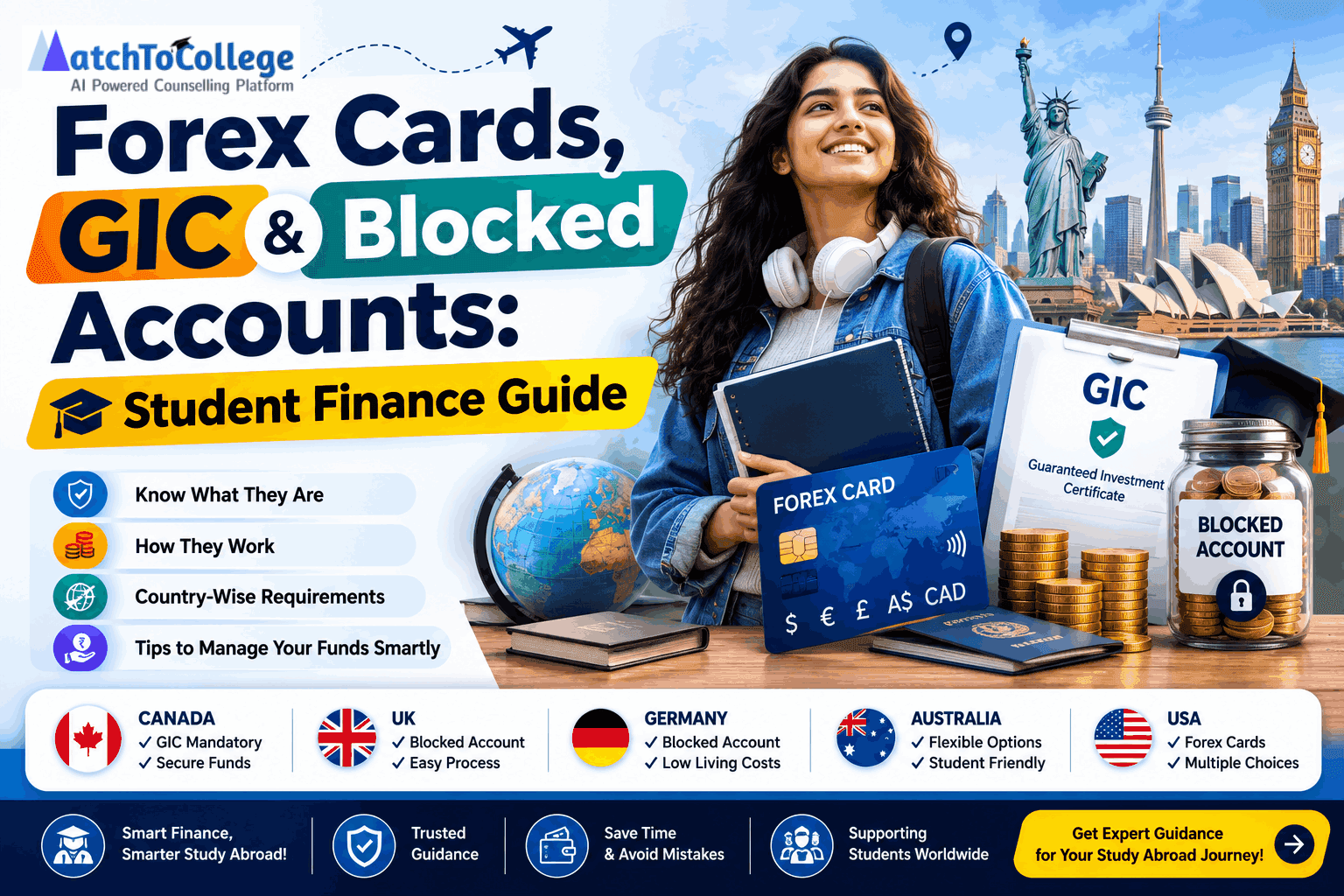
As of January 1, 2024, the Canadian government more than doubled the cost-of-living requirement for international students, raising the Guaranteed Investment Certificate (GIC) amount from $10,000 to $20,635 (CAD). This shift underscores a global trend where immigration authorities are tightening financial verification to ensure students can sustain themselves without local employment.
Managing these high-value transfers requires more than just a bank account; it involves navigating the Reserve Bank of India’s Liberalised Remittance Scheme (LRS), which allows for up to USD 250,000 in foreign exchange per financial year. However, once your remittance for education exceeds ₹7 lakhs, a Tax Collected at Source (TCS) of 0.5% (if funded by a loan) or 5% (if self-funded) applies.
At MatchToCollege, we monitor these regulatory shifts to provide precise data for your budgeting phase. Understanding the technical differences between a Forex card for daily expenses, a GIC for Canadian compliance, and a Blocked Account for German visa requirements is critical to avoiding visa delays or financial shortfalls during your first semester abroad. This guide breaks down the mechanics of each instrument, the associated fees, and the strategic timing required for currency conversion.
Before committing to an international program, it is essential to look at the long-term financial picture. You can use our Calculate Your University ROI Compare tool to see how these upfront financial requirements align with your post-graduation earning potential. For those still in the early stages of planning and considering domestic alternatives, our JEE Rank Predictor can help you evaluate your standing in the Indian competitive landscape before you commit to the high costs of foreign remittance.
Understanding the $20,635 CAD Requirement: The Modern GIC Landscape
The Guaranteed Investment Certificate (GIC) is a mandatory financial instrument for students applying through the Student Direct Stream (SDS) for Canada. It acts as a proof of funds, ensuring the Canadian government that you have the means to cover your first year of living expenses. Unlike a standard savings account, a GIC is a non-redeemable investment for a fixed term.
Once you arrive in Canada, you receive an initial lump sum (usually around $4,000 CAD) to help with setup costs, while the remaining balance is disbursed in monthly installments over 10 to 12 months. This structured payout prevents students from exhausting their funds prematurely. When selecting a bank for your GIC—such as Scotiabank, CIBC, or ICICI Bank Canada—pay close attention to the administrative fees, which typically range from $150 to $200 CAD.
The timing of your GIC application is vital. You must account for the time it takes for the bank to process your application and for the wire transfer to reflect in your Canadian account, which can take 5 to 10 business days. If you are converting large sums of Indian Rupees, use our million to rupees calculator to estimate the total capital requirement in your home currency. Remember that the exchange rate you see on Google is the 'interbank rate'; the rate offered by banks for a GIC transfer will usually include a markup of 1% to 3%.
Furthermore, you must ensure that the name on your GIC application matches your passport exactly, as discrepancies can lead to significant delays in receiving your Investment Confirmation—a document required for your visa application. If you are calculating the interest on a potential loan to cover this GIC, our Education Loan EMI Calculator can provide a clear breakdown of your monthly repayment obligations once your grace period ends.
Forex Cards vs. Multi-Currency Accounts: Minimizing Transaction Friction
While GICs and Blocked Accounts handle your visa compliance, a Forex card is your primary tool for daily survival. Unlike a standard debit card, which charges a 'Foreign Currency Markup' of 3.5% plus GST on every transaction, a Forex card allows you to lock in exchange rates when they are favorable. This 'loading' process protects you from currency volatility.
For instance, if the Rupee depreciates by 2% while you are abroad, your pre-loaded Forex card balance remains unaffected. Modern Forex cards are multi-currency, meaning you can load USD, CAD, EUR, and GBP onto a single chip, which is ideal for students planning to travel across the Schengen area or during layovers.
When choosing a Forex card, prioritize those with zero cross-currency markup and no ATM withdrawal fees (though the local ATM provider might still charge a fee). Some providers now offer 'Student Special' cards that include discounted rates on courier services or international SIM cards. Beyond the card, consider opening a local bank account as soon as you arrive.
This is necessary for paying rent, receiving salary from part-time jobs, and setting up utilities. For students who are currently evaluating their academic path and looking at the financial feasibility of different careers, our Career Pathway Matcher can help align your choice of study with a location that offers the best balance of living costs and earning potential. Managing your finances effectively starts with choosing the right degree in the right city, where your Forex card balance can stretch further.
Share this Article
FAQFrequently Asked Questions
Q: Can I use my GIC funds to pay for my tuition fees?
No, GIC funds are specifically designated for living expenses. You must pay your tuition fees separately to the university. The GIC amount is released to you in installments only after you land in Canada and open a local bank account.
Q: What happens to my Blocked Account if my German visa is rejected?
If your visa is rejected, you can request a refund. You will need to provide the official rejection letter from the German Consulate. The provider will then release the funds back to the original source account, though administrative fees and bank transfer charges are usually non-refundable.
Q: Is a Forex card better than a credit card for students?
Yes, a Forex card is generally better because it locks in the exchange rate, avoiding the 3.5% markup often found on credit cards. Additionally, it prevents overspending as it is a prepaid card, and it carries lower risk since it is not linked to your primary bank account.
Get More Info About Forex Cards, GIC & Blocked Accounts
Recommended Reading

NEET Exam Tomorrow: Last-Minute Strategy to Maximize Your Score
NEET is tomorrow—here’s your complete last-day strategy covering revision, exam hall tips, and mistakes to avoid for maximum accuracy and performance.
GATE Previous Year Question Papers with Official Answer Keys (2007–2026) – Download PDF by Branch
Download official GATE previous year question papers with answer keys PDF from 2007 to 2026. Access branch-wise question papers for Computer Science (CS), Data Science (DA), Mechanical (ME), Electronics (EC), Electrical (EE), and Civil (CE) by IIT Madras.
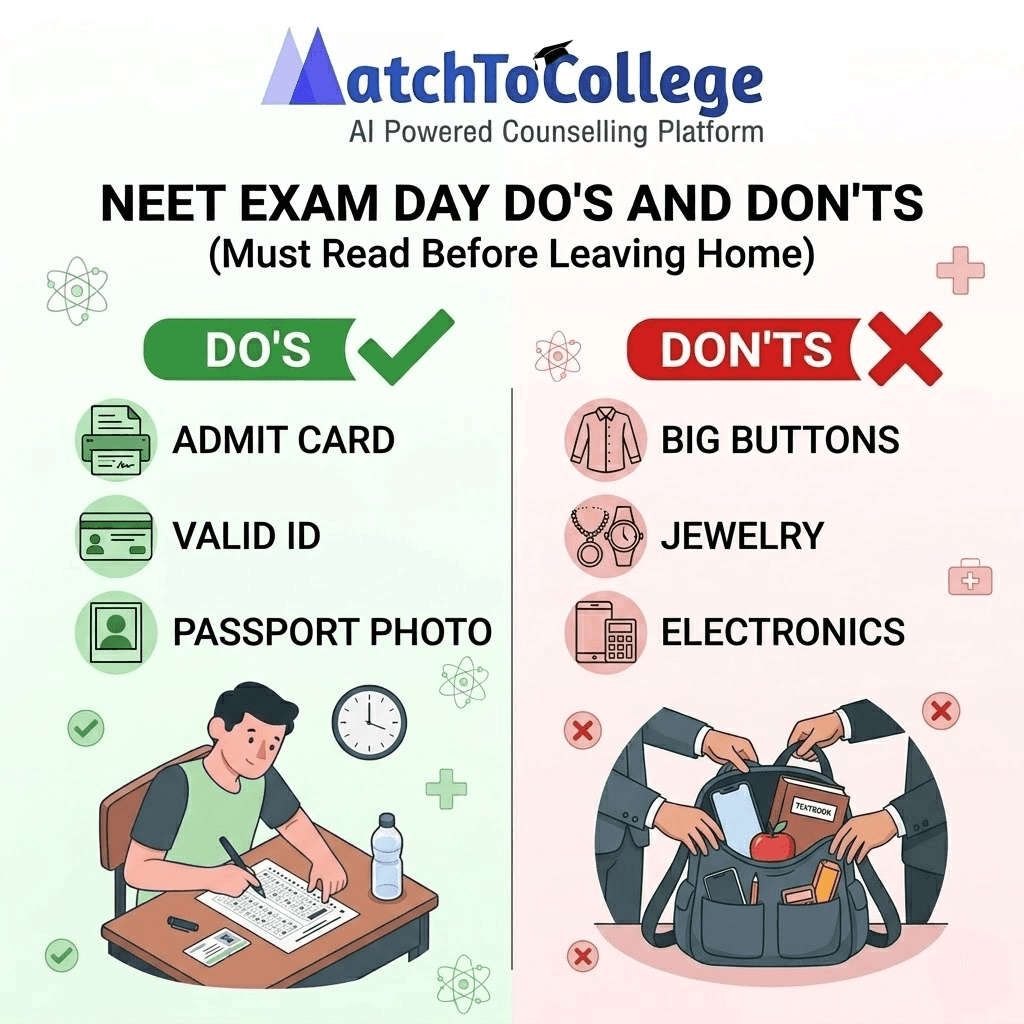
NEET Exam Day Do’s and Don’ts (Must Read Before Leaving Home)
Students appearing for the National Eligibility cum Entrance Test (NEET) must follow strict exam day guidelines set by the National Testing Agency. From required documents and dress code to prohibited items, this guide covers the most important NEET exam day do’s and don’ts to help candidates avoid last-minute problems at the exam center.