

Tax Benefits on Education Loans: How Section 80E can save you lakhs in the long run.
Admission & Info Tools
Need Expert Assistance?
Our counselors can help you with fee structures, eligibility guidelines, and upcoming admission cutoffs instantly.
Direct Application Tools

Smart Savings Through Education Loans
Pursuing higher education, whether an MBA, engineering degree, medical course, or study abroad program, often involves significant financial investment. For many students and their families, an education loan becomes a crucial stepping stone to achieving academic and career aspirations. While the prospect of loan repayment can seem daunting, did you know that the Indian tax system offers substantial relief that can save you lakhs in the long run?
At MatchToCollege, your AI-powered guide to higher education, we understand that smart financial planning is just as important as choosing the right course or college. One of the most powerful tools in your financial arsenal is Section 80E of the Income Tax Act. This provision allows you to deduct the entire interest paid on your education loan from your taxable income, offering a significant advantage that many often overlook.
Imagine cutting down your taxable income by a substantial amount each year, directly translating into lower tax outgoings. This isn't just a small saving; it's a strategic financial move that can dramatically ease your repayment burden and free up funds for other investments or necessities. Understanding the nuances of Section 80E is vital for anyone taking an education loan, as it empowers you to make informed decisions and maximize your financial benefits. Let's delve deep into how this section works and how you can leverage it to your advantage.
What is Section 80E of the Income Tax Act?
Section 80E is a provision under the Indian Income Tax Act, 1961, that allows individuals to claim a deduction for the entire interest amount paid on an education loan. This deduction is available for loans taken for higher education, for self, spouse, or children, or for a student for whom the individual is the legal guardian. Unlike some other deductions that have a cap, Section 80E allows you to deduct the full interest paid, making it incredibly powerful for significant savings.
It's crucial to understand that this deduction is only for the interest component of the EMI (Equated Monthly Installment), not the principal amount. The principal repayment does not qualify for deduction under Section 80E. This tax benefit aims to encourage higher education by easing the financial burden on borrowers during their repayment period.
Who Can Claim 80E Benefits & What Loans Qualify?
To avail the benefits of Section 80E, specific criteria must be met:
- Assessee: The deduction can only be claimed by an individual, not by a Hindu Undivided Family (HUF) or a company.
- Loan Source: The education loan must be taken from any approved financial institution (banks) or any approved charitable institution. Loans from relatives or friends do not qualify.
- Purpose of Loan: The loan must be specifically for 'higher education'. Higher education broadly includes any course of study pursued after completing the Senior Secondary Examination or its equivalent, covering both vocational and professional courses, in India or abroad.
- Beneficiary: The loan should be for the higher education of:
- The individual themselves
- Their spouse
- Their children
- A student for whom the individual is the legal guardian
- Duration of Deduction: The deduction is available for a maximum of 8 assessment years, starting from the assessment year in which you begin paying interest on the loan, or until the interest is fully repaid, whichever is earlier.
Always ensure you obtain an interest certificate from your lender at the end of each financial year, detailing the interest and principal components of your repayments. This document is vital for claiming your deduction.
How Section 80E Can Save You Lakhs: A Practical Example
Let's illustrate the power of Section 80E with a practical scenario:
Suppose you take an education loan of ₹30 Lakhs at an interest rate of 10% per annum for a tenure of 10 years. Your annual interest payment in the initial years would be substantial. Let's say in the first year, the total interest paid is ₹2,80,000.
- Without 80E: Your taxable income remains unchanged by the interest paid.
- With 80E: You can deduct the entire ₹2,80,000 from your gross total income.
If you fall into the 30% tax bracket (plus cess), your tax saving in that year alone would be approximately 30% of ₹2,80,000 = ₹84,000!
Over the 8-year deduction period, as the interest component decreases, your cumulative savings can easily run into several lakhs. For instance, if your average annual interest deduction over 8 years is ₹1,50,000, your total tax savings would be around ₹1,50,000 * 8 * 30% = ₹3,60,000 (assuming a consistent tax bracket).
This substantial saving directly reduces your out-of-pocket expenses for the loan, making higher education more affordable and less burdensome. It's a key reason why understanding and utilizing Section 80E is paramount for every student and parent.
Key Points and Best Practices for Maximizing Your Benefits
- Maintain Records: Always keep detailed records of your loan statements and interest certificates provided by your bank. These are essential for filing your Income Tax Return.
- No Upper Limit: One of the biggest advantages is that there is no maximum limit on the amount of interest you can claim as a deduction under Section 80E. The entire interest paid is deductible.
- Tax-Paying Individual: The deduction can only be claimed by the individual who is repaying the loan and has taxable income. If a parent takes the loan for their child, the parent can claim the deduction. If the child starts repayment and has taxable income, they can claim it.
- Timely Repayment: While not directly related to tax benefits, timely repayment helps maintain a good credit score and avoids additional penalties or interest.
- Start Early: The 8-year clock for claiming benefits starts from the year you begin interest payments. Plan your repayment to maximize deductions within this period.
Navigating the financial aspects of higher education can be complex, but with platforms like MatchToCollege, you gain access to comprehensive guidance, from admission strategies to financial planning insights. Understanding provisions like Section 80E empowers you to make informed decisions, ensuring your journey to academic success is financially sound and rewarding.
Share this Article
FAQFrequently Asked Questions
Q: Can both parents claim the 80E deduction if they both contribute to the education loan?
No, only one individual can claim the deduction for the interest paid on an education loan. If both parents are co-borrowers and jointly paying the interest, they would need to decide who claims the deduction for the entire interest paid, or they can split the interest paid and claim deductions proportionally if the loan agreement allows for individual repayment shares.
Q: Is there any limit on the amount of interest that can be claimed under Section 80E?
No, there is no upper limit on the amount of interest that can be claimed as a deduction under Section 80E. The entire interest paid on the education loan in a financial year is eligible for deduction from your taxable income, subject to the 8-year limit for claiming the benefit.
Q: What if my education loan is from an individual or a private lender?
Section 80E benefits are only applicable if the education loan is taken from an approved financial institution (like banks, NBFCs, or specified financial corporations) or an approved charitable institution. Loans taken from individuals, friends, or private lenders do not qualify for deduction under Section 80E.
Get More Info About Tax Benefits on Education Loans
Recommended Reading

Best Online MBA Specializations for High-Paying Careers 2026
Discover the most lucrative online MBA specializations for 2026-27. Compare ROI, career growth, and use our AI tools to find your perfect management path.

Top Career Opportunities After an Online MBA in 2026-27
Discover high-paying career paths and roles after an online MBA in 2026-27. Explore salary trends, ROI, and tools to navigate your future professional success.
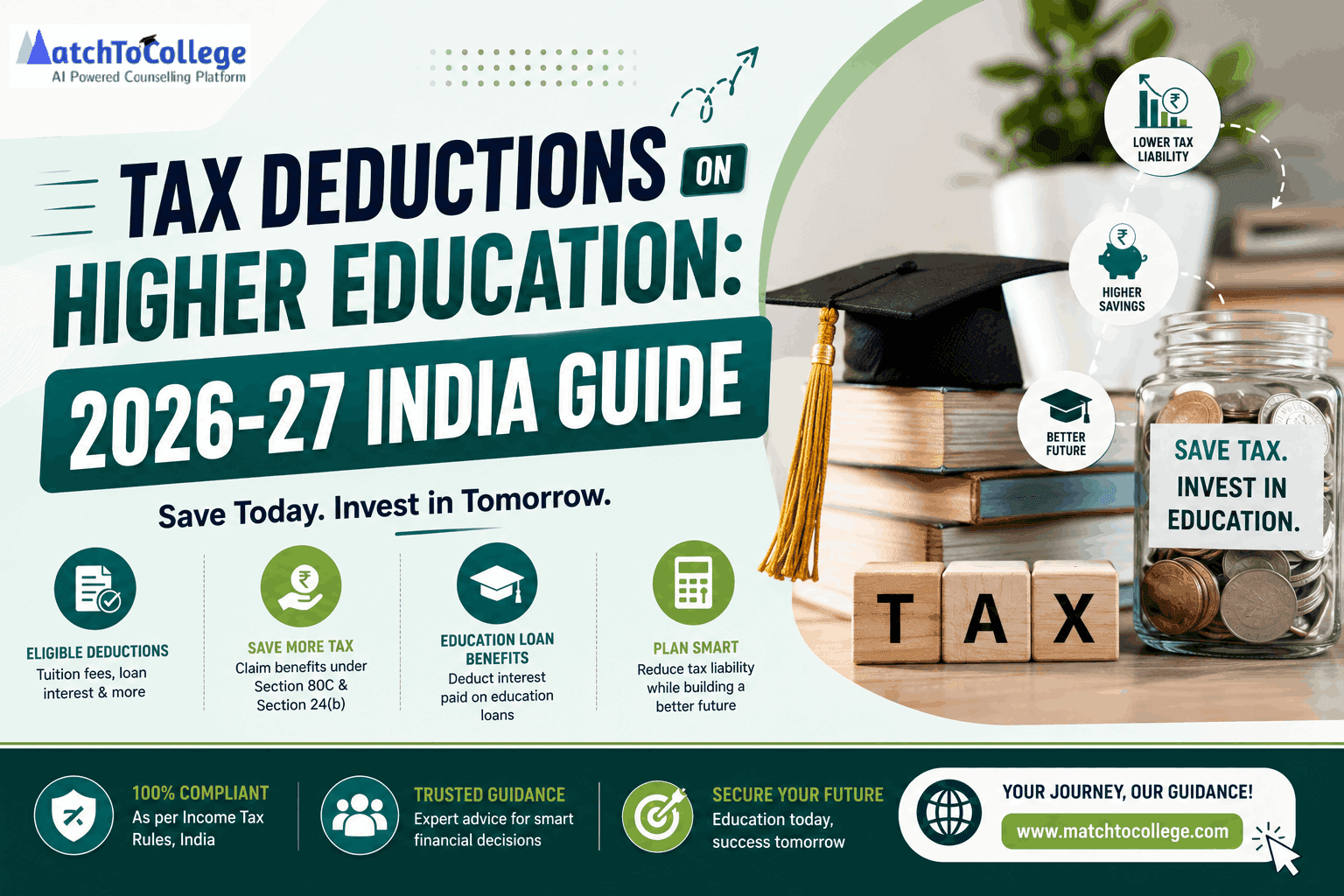
Tax Deductions on Higher Education: 2026-27 India Guide
Maximize your savings with our guide on tax deductions for higher education fees in India for FY 2026-27. Learn about Section 80C, 80E, and upskilling benefits.