

Digital Badges: Outrank MBA with 3 Micro-credentials
Admission & Info Tools
Need Expert Assistance?
Our counselors can help you with fee structures, eligibility guidelines, and upcoming admission cutoffs instantly.
Direct Application Tools

Digital Badges: Outrank MBA with 3 Micro-credentials
In today's rapidly evolving job market, the traditional path to career success, often paved with a prestigious MBA, is facing a powerful challenger: digital badges and micro-credentials. While an MBA has long been the gold standard for leadership and business acumen, its significant investment in time and money can be a barrier for many, especially when industries are demanding hyper-specific, agile skill sets. What if we told you that by strategically acquiring just three targeted micro-credentials, you could build a profile that not only competes with but potentially outranks an MBA candidate in specific, high-demand roles?
The future of education and career advancement isn't solely about broad degrees; it's about demonstrated competence and continuous skill development. Employers are increasingly valuing verifiable skills over lengthy academic histories. This shift opens up unprecedented opportunities for students and professionals to tailor their learning, acquire cutting-edge expertise, and accelerate their career trajectory without the traditional constraints.
This blog post will delve into the transformative power of digital badges and micro-credentials. We'll explore what they are, why they're gaining traction, and most importantly, how to strategically stack them to create a unique, highly competitive professional identity. Get ready to discover a smarter, faster, and more targeted route to securing your dream job and advancing your career, leveraging the expertise of platforms like MatchToCollege to guide your every step towards building a future-proof skill portfolio.
The Shifting Landscape: Why Micro-credentials Matter Now More Than Ever
The speed of innovation today means that skills acquired five years ago might already be outdated. Traditional degrees, by their very nature, often struggle to keep pace with these rapid industry changes. Enter micro-credentials and digital badges – verifiable attestations of specific competencies that can be earned in weeks or months, not years. This shift reflects a growing demand for lifelong learning and agile skill acquisition. Businesses are no longer just looking for generalists; they need specialists who can immediately contribute to niche projects in areas like AI, cybersecurity, data analytics, or digital marketing. This focus on demonstrable, up-to-date skills is where micro-credentials truly shine, offering a flexible and cost-effective alternative to lengthy educational programs.
What Are Digital Badges & Micro-credentials?
At their core, digital badges and micro-credentials are concise, verifiable certifications that attest to the acquisition of a specific skill or competency. Unlike a broad degree, a micro-credential focuses intensely on one area, ensuring deep, practical knowledge. These credentials are often awarded by universities, industry leaders (like Google, IBM, Microsoft), or specialized online platforms (e.g., Coursera, edX, Udacity). They are typically backed by metadata, sometimes even blockchain technology, making them transparent, secure, and easily verifiable by potential employers. They represent a modular approach to education, allowing individuals to build a personalized and highly relevant skill stack that aligns directly with current workforce readiness demands.
The Strategy: Stacking 3 Micro-credentials to Outshine an MBA
Here's where the magic happens. While an MBA offers a broad business education, a carefully curated stack of micro-credentials offers specialized, in-demand expertise, often at a fraction of the cost and time. Consider these examples:
- For Tech Leadership: Instead of a traditional MBA, stack 'Advanced Python for Data Science' (e.g., from a university extension or DataCamp) + 'Cloud Architecture Certification' (e.g., AWS Certified Solutions Architect) + 'Agile Project Management Professional' (e.g., PMI-ACP). This combination demonstrates hands-on technical leadership, strategic cloud understanding, and modern project execution – making you immediately valuable in a tech-driven role, often more so than an MBA generalist.
- For Digital Business Strategy: Combine 'Digital Marketing Analytics' (e.g., Google Analytics Certification) + 'UX/UI Design Foundations' (e.g., from Coursera/Google) + 'AI for Business Strategy' (e.g., from an executive education platform). This provides a potent mix of data-driven marketing, customer-centric design, and future-forward strategic thinking, directly addressing contemporary business challenges.
The key is choosing complementary micro-credentials that build a compelling narrative around a specialized career trajectory, showcasing depth and direct applicability over a generalist approach. This targeted approach offers a significantly higher return on investment (ROI) in many specialized fields.
Finding Your Path: How MatchToCollege Guides Your Micro-credential Journey
Navigating the vast landscape of micro-credentials can be daunting. This is where MatchToCollege steps in. Our AI-powered platform helps you identify your strengths, career aspirations, and the specific skills gaps you need to fill to achieve your goals. We analyze real-time job market data and industry trends to recommend the most impactful digital badges and micro-credentials tailored to your unique profile. Whether you're aiming to shift careers, boost your earning potential, or simply stay ahead of the curve, MatchToCollege provides personalized guidance, connecting you to top providers and helping you strategically stack your way to unparalleled career advancement. Don't just follow the crowd; forge your own powerful path with informed choices and verifiable skills.
Share this Article
FAQFrequently Asked Questions
Q: Are digital badges truly recognized by employers?
Yes, increasingly so. Employers, particularly in tech and rapidly evolving industries, highly value digital badges and micro-credentials because they demonstrate specific, verifiable, and in-demand skills. Many reputable universities and industry leaders like Google, IBM, and Microsoft offer these credentials, enhancing their recognition and credibility in the job market.
Q: How do micro-credentials compare to a full degree in terms of cost and time?
Micro-credentials offer significant advantages in both cost and time. A full degree, especially an MBA, can cost tens to hundreds of thousands of dollars and take 1-2 years or more. In contrast, most micro-credentials can be earned in weeks or a few months, typically costing anywhere from a few hundred to a few thousand dollars, providing a much faster and more affordable path to skill acquisition and career advancement.
Q: Can MatchToCollege help me find the right micro-credentials?
Absolutely. MatchToCollege's AI-powered platform is designed to provide personalized higher education and career counseling. We analyze your academic background, career aspirations, and current market demands to recommend the most relevant and impactful digital badges and micro-credentials, helping you build a strategic stack that maximizes your competitive edge and prepares you for future success.
Get More Info About Digital Badges
Recommended Reading
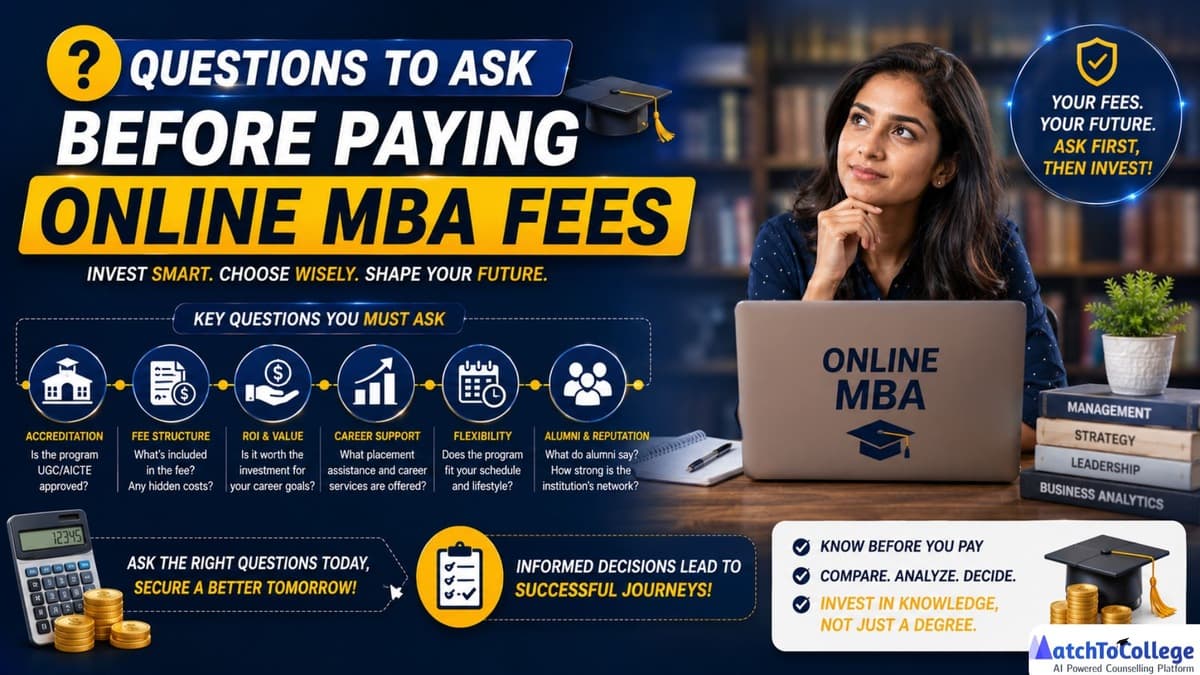
Online MBA Fees: 7 Vital Questions Before You Commit
Paying for an Online MBA? Don't rush! Discover 7 essential questions to ask about accreditation, costs, and career services before you pay your fees. Make a smart investment.

Top Careers After MBA in Marketing: Your Future Unlocked
Unlock your potential! Discover the most lucrative and impactful careers after an MBA in Marketing. From brand management to digital strategy, find your path.
Boost Your Career: The Power of an Online MBA
Unlock career growth with a flexible Online MBA. Discover top programs, navigate applications, and balance work-life. Your professional future starts here.