

CAT 2026 Selection Process: IIM Admission Guide & Roadmap
Admission & Info Tools
Need Expert Assistance?
Our counselors can help you with fee structures, eligibility guidelines, and upcoming admission cutoffs instantly.
Direct Application Tools
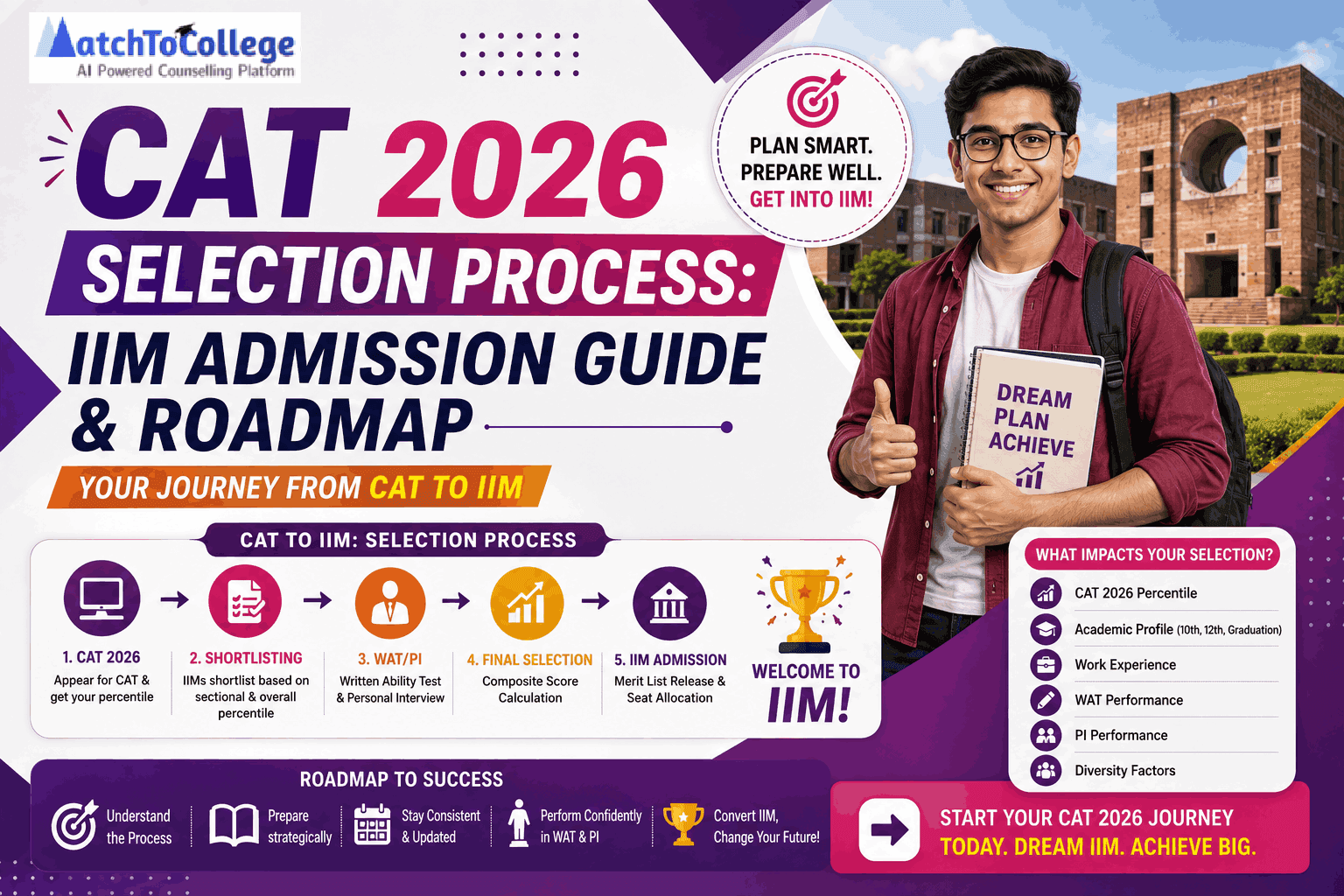
Embarking on the journey toward a Master of Business Administration (MBA) at one of the prestigious Indian Institutes of Management (IIMs) is a transformative career move. However, as most aspirants realize, clearing the Common Admission Test (CAT) is merely the first gate in a multi-layered marathon.
The CAT 2026 selection process is expected to be more competitive than ever, demanding not just a high percentile but a well-rounded academic and professional profile. For students aiming for the 2026-28 batch, understanding the nuances of the roadmap from exam day to the final offer letter is crucial. At MatchToCollege, we leverage AI-driven insights to help you navigate this complex landscape. If you are wondering where your current preparation stands, using our CAT College Predictor can give you an early look at potential IIM calls based on projected scores.
The IIM admission process is notoriously rigorous because it seeks to identify future leaders who possess not only quantitative and verbal aptitude but also critical thinking, communication skills, and emotional intelligence. In 2026, the selection criteria are likely to place even greater emphasis on ‘Academic Diversity’ and ‘Work Experience,’ aiming to move beyond the traditional engineer-heavy classrooms of the past. This means that even before you sit for the exam in November 2025 (for the 2026 session), you need to strategically plan your profile. Are you maintaining a high GPA? Have you calculated your academic weights using the CGPA to Percentage Calculator to see how you measure up against IIM benchmarks? These are the questions that define a successful candidate.
Furthermore, the post-CAT stages, including the Writing Ability Test (WAT) and Personal Interview (PI), carry significant weightage—often higher than the CAT score itself in the final merit list. Many 99+ percentilers find themselves on the waitlist because they underestimated the complexity of the interview rounds. This guide provides a comprehensive roadmap, breaking down every stage of the CAT 2026 selection process. We will explore how different IIMs (Blacki: Bangalore, Lucknow, Ahmedabad, Calcutta, Kozhikode, Indore vs. New and Baby IIMs) vary their selection criteria and how you can optimize your chances at each step. Whether you are a fresh graduate or a working professional, the path to an IIM requires a mix of data-backed planning and exceptional performance.
Stage 1: The CAT 2026 Examination and Sectional Mastery
The selection process begins with the Common Admission Test (CAT). For the 2026 admission cycle, the exam is anticipated to follow the established three-section format: Verbal Ability and Reading Comprehension (VARC), Data Interpretation and Logical Reasoning (DILR), and Quantitative Ability (QA). The primary hurdle here is not just the overall percentile but the sectional cut-offs. Most top-tier IIMs require a candidate to clear a minimum percentile in each of the three sections to even be considered for the next round. For instance, an overall 99 percentile with a 70 percentile in DILR might result in zero calls from the top 6 IIMs.
Aspirants must realize that the CAT score is 'normalized' across different slots to ensure fairness. This normalized score is then converted into a percentile, which represents your rank relative to the total number of test-takers. While you prepare for these sections, it is vital to keep an eye on your career trajectory. You can use our Career Pathway Matcher to ensure that an MBA is truly the right step for your long-term goals. Once the results are declared in late December or early January, the IIMs release their individual shortlists for the Second Stage. These shortlists are based on the ‘Composite Score,’ which includes your CAT performance plus several other factors we will discuss in the next section.
It is also important to note that CAT is not the only exam; however, it is the most widely accepted. While focusing on CAT, many students also look at other professional avenues. If you are a student coming from a science background or considering diverse fields, you might also be interested in our JEE Main 2026 Rank Predictor or NEET 2026 Rank Predictor, though these are for different educational paths. For MBA aspirants, the focus remains strictly on maximizing the CAT scaled score through rigorous mock tests and analysis.
Stage 2: The Shortlisting Criteria and Composite Score Calculation
After the CAT results are out, each IIM independently announces its shortlist for the WAT-PI round. This is where the concept of a 'Composite Score' (CS) becomes vital. Every IIM has its own formula for calculating the CS, and it is rarely based 100% on the CAT score. In fact, for many IIMs, the CAT score weightage ranges only between 30% to 60%. The remaining components of the CS usually include 10th-grade marks, 12th-grade marks, Graduation marks, Work Experience, and Gender/Academic Diversity points.
For example, IIM Ahmedabad and IIM Bangalore place a high premium on consistent academic excellence from school through college. If your university uses a CGPA system, ensuring you convert it correctly using the SGPA to Percentage Calculator is essential for self-evaluation. Work experience is another critical factor; generally, 24 to 36 months of experience is considered the 'sweet spot' for maximum points. Beyond 48 months, the points may actually start to decrease at some institutes. Furthermore, non-engineering students (Arts, Commerce, Medicine) and female candidates often receive 2-5 bonus points to promote classroom diversity.
Understanding this stage helps you manage expectations. If you have a slightly lower CAT score but an stellar academic record, you might still get a call from IIM Bangalore. Conversely, a 99.9 percentile candidate with poor 10th/12th marks might miss out on IIM Indore. To check out your broader college options beyond the IIMs, visit our Domestic Colleges listing page to see which private B-schools align with your profile and score.
Stage 3: The WAT-PI Round – Where Finalists are Born
Candidates who make the shortlist are invited for the Writing Ability Test (WAT) and Personal Interview (PI). This is arguably the most subjective and challenging part of the CAT 2026 selection process. In the WAT, you are typically given a topic—ranging from current affairs and philosophy to business ethics—and asked to write a 200-400 word essay within 15-30 minutes. The evaluators look for clarity of thought, logical structuring, and command over the language.
The Personal Interview (PI) follows the WAT. Here, a panel of professors and alumni will grill you on everything from your academic background and work experience to your ‘Why MBA?’ justification. They are testing your stress management, communication skills, and leadership potential. It is not just about what you know, but how you present it. Many candidates use this time to also evaluate the Return on Investment (ROI) of the specific IIM they are interviewing for. Our University ROI Calculator can help you compare the long-term value of various management programs.
During the PI, questions often touch upon your future aspirations. Are you on the right path? Using the Career Pathway Matcher can help you articulate your career goals more clearly during the interview. Remember, the PI can account for 30% to 50% of the final selection weightage. It is the make-or-break moment where a candidate with a lower CAT score can leapfrog over a higher-ranked peer by demonstrating superior personality traits and clarity of vision.
Stage 4: CAP and the Selection Process for New & Baby IIMs
While the 'Old IIMs' (BLACKI) conduct their own individual interviews, the New IIMs (such as Udaipur, Trichy, Raipur, Ranchi, Kashipur, and Sambalpur) and Baby IIMs (such as Bodh Gaya, Sirmaur, and Jammu) often participate in a Common Admission Process (CAP). Under CAP, a single IIM (usually rotating each year) coordinates the WAT and PI rounds for all participating institutes. This means you only have to attend one interview, and your performance is shared across all member IIMs.
The CAP process is a boon for students as it saves time and travel expenses. However, the competition is fierce because the number of applicants is massive. Each IIM in the CAP group will later release its own separate merit list based on its specific weightage for the CAP interview score and the candidate's profile. For students who might not make it into the top IIMs, exploring alternatives is key. You can look into the CUET PG College Predictor if you are considering other central university management programs as a backup.
Even in the CAP process, the 'Final Selection' is a mix of your CAT score, CAP PI score, and Profile score. If you find yourself needing to calculate your age for eligibility or work experience documentation during the application, our Age Calculator is a handy tool. The New IIMs have seen a massive surge in placements recently, making them highly desirable for CAT 2026 aspirants who want the IIM brand name with slightly more flexible entry barriers compared to the 'Holy Trinity' (A, B, C).
Stage 5: Final Admission Offer and Financial Planning
The final merit list is usually released between April and May. If you are lucky enough to receive an offer letter, you will typically have a week or two to accept the offer by paying a commitment fee (usually around ₹50,000 to ₹1,00,000). If you are on the waitlist, you will need to monitor the 'movement' closely. Waitlist movement depends on how many selected candidates choose other institutes or drop out.
Once the admission is secured, the next big hurdle is financing. IIM fees for the 2026-28 batch are expected to range from ₹18 Lakhs to ₹30 Lakhs. While this seems daunting, most IIMs have tie-ups with major banks for collateral-free loans. To plan your finances effectively, we highly recommend using our Education Loan EMI Calculator. This will help you understand your monthly repayment obligations after graduation and help you decide if the program fits your financial health.
Additionally, for those who might be considering pursuing an MBA or other higher education degrees online or via distance learning to save on costs, checking the Online Degree Passing Predictor can be useful to see if you have the discipline to finish such a program. However, for a full-time IIM experience, the focus should remain on the transformative on-campus culture and networking opportunities that justify the high tuition fees.
Summary: Checklist for CAT 2026 Aspirants
To succeed in the CAT 2026 selection process, you must be a marathon runner, not a sprinter. Your checklist should include: 1) Achieving a balanced sectional CAT score. 2) Maintaining high academic percentages (use the GPA to Percentage Calculator for accuracy). 3) Gaining quality work experience. 4) Building a diverse profile through certifications and extracurriculars. 5) Excelling in the WAT-PI rounds by staying updated on global trends.
At MatchToCollege, we are dedicated to providing the tools you need for every step of this journey. From our CAT College Predictor to our career counseling resources, we ensure you are never walking alone. Remember, an IIM admission is not just a reward for an exam; it is a recognition of your potential to lead. Stay focused, use the right data tools, and prepare to join the ranks of India's business elite in 2026.
Share this Article
FAQFrequently Asked Questions
Q: What is a good CAT 2026 percentile for IIM Ahmedabad?
For general category students, a percentile above 99.5 is usually required, provided you have a very strong academic profile (10th, 12th, and Graduation). Non-engineers might get calls at slightly lower percentiles like 98.5+ due to academic diversity points.
Q: Do IIMs consider 10th and 12th marks?
Yes, most IIMs (especially IIM Indore, Bangalore, and Ahmedabad) give significant weight (up to 20-30%) to your 10th and 12th-grade scores in the initial shortlisting and final merit list.
Q: Is work experience mandatory for CAT 2026?
No, work experience is not mandatory. Freshers can and do get into IIMs every year. However, having 12-36 months of work experience gives you extra points in the 'Composite Score' calculation.
Q: What is the CAP process in IIMs?
The Common Admission Process (CAP) is a unified interview process conducted for the New and Baby IIMs, where a candidate attends one interview that is valid for all participating institutes.
Top Colleges Covered in this Blog


Indian Institute of Management Bangalore
Indian Institute of Management Bangalore
Indian Institute of Management Bangalore (IIMB) is one of India’s leading business schools and an Institute of National Importance. Established in 1973, it offers postgraduate, doctoral, and executive programs in management. The institute is known for academic excellence, global collaborations, strong research output, and top-tier placements across consulting, finance, and technology sectors.
Total Fees
₹2.6L - ₹33.7L
Total Courses
3


Indian Institute of Management Lucknow
Indian Institute of Management Lucknow
Indian Institute of Management Lucknow (IIML) is one of the premier management institutes in India, established in 1984. It is recognized as an Institution of National Importance and is known for its excellence in management education, research, and leadership development. IIM Lucknow offers postgraduate, executive, and doctoral programs in management and consistently ranks among the top business schools in India.
Total Fees
₹4.3L - ₹26.3L
Total Courses
7
Get More Info About CAT 2026 Selection Process
Recommended Reading

LBSIM Delhi & GIBS 2027 Admissions Open: Apply Online Now
LBSIM Delhi and GIBS Bangalore open 2027 admissions. Explore PGDM, MBA, and BBA application details, early bird offers, and WBJEE/TNEA 2026 counseling updates.

Best Online MBA Specializations for High-Paying Careers 2026
Discover the most lucrative online MBA specializations for 2026-27. Compare ROI, career growth, and use our AI tools to find your perfect management path.

Top Career Opportunities After an Online MBA in 2026-27
Discover high-paying career paths and roles after an online MBA in 2026-27. Explore salary trends, ROI, and tools to navigate your future professional success.