

CAT 2026 Difficulty: What to Expect This Year?
Admission & Info Tools
Need Expert Assistance?
Our counselors can help you with fee structures, eligibility guidelines, and upcoming admission cutoffs instantly.
Direct Application Tools
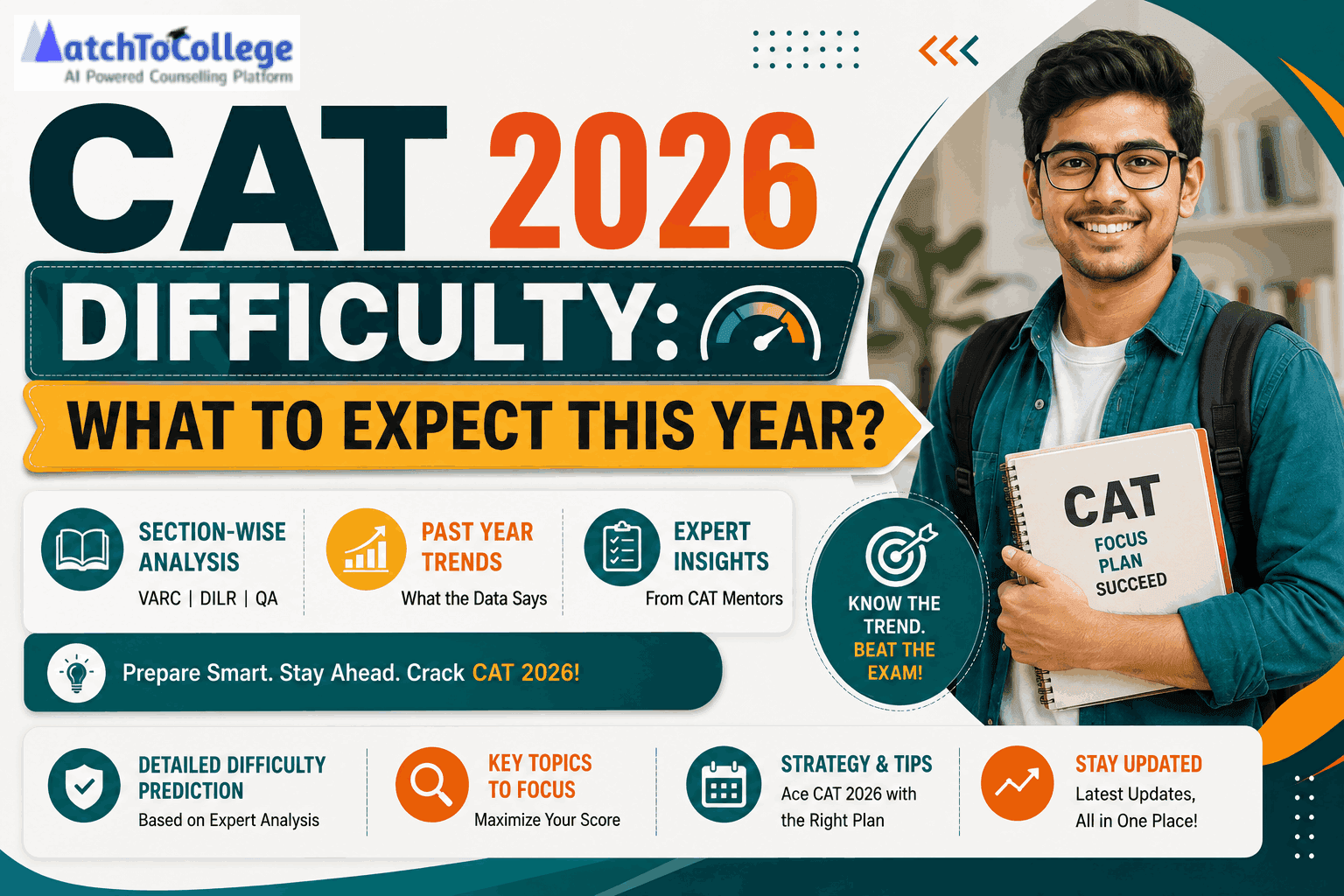
Every year, thousands of MBA aspirants set their sights on cracking the Common Admission Test (CAT), the gateway to India's premier B-schools, including the prestigious IIMs.
As we look ahead to CAT 2026, a common question echoes among students: "What will be the difficulty level this year?" The CAT exam is renowned for its dynamic nature, with IIMs often introducing subtle or significant changes that impact its perceived toughness. Understanding these potential shifts is crucial for effective preparation.
At MatchToCollege, your AI-powered higher education counselling platform, we analyze historical trends, expert predictions, and potential modifications to provide you with a clear perspective.
This guide will delve into what factors might influence CAT 2026 difficulty, how to anticipate changes, and most importantly, how to strategize your preparation to ace the exam, regardless of its challenge. Whether you're just starting your preparation or fine-tuning your strategy, knowing what to expect can be your biggest advantage.
Analyzing Past CAT Difficulty Trends
To predict the future, it’s essential to understand the past. Over the last few years, the CAT exam has displayed a fluctuating difficulty graph.
While the core structure (Verbal Ability & Reading Comprehension - VARC, Data Interpretation & Logical Reasoning - DILR, and Quantitative Aptitude - QA) remains consistent, the distribution of questions, type of questions, and overall challenge within each section can vary significantly.
For instance, CAT 2023 was widely considered to have a moderate to high difficulty, especially in the DILR section, which often serves as a primary differentiator. Earlier iterations like CAT 2022 and 2021 also presented their unique challenges, often swinging between slightly easier VARC and tougher DILR/QA, or vice-versa.
Key takeaways from previous years indicate that IIMs strive for a balanced test that assesses a candidate's aptitude across multiple dimensions. There's a constant effort to minimize predictability while ensuring fairness.
This means CAT 2026 is unlikely to be a carbon copy of any previous year, but rather an evolution. Analyzing trends in question types – be it passage length in VARC, complexity of sets in DILR, or conceptual depth in QA – helps us prepare for potential scenarios.
MatchToCollege's extensive database of past exam analyses provides valuable insights into these patterns, helping you identify areas of focus.
Factors Influencing CAT 2026 Difficulty
Several factors can collectively determine the CAT 2026 difficulty level. Understanding these can help aspirants adapt their study plans:
- Exam Pattern & Syllabus Changes: While major overhauls are rare, minor tweaks in the number of questions per section, time allocation, or introduction of new question types (e.g., TITA vs. MCQs) can alter the perceived difficulty. Any such notification from the IIMs should be closely monitored.
- Competition Level: An increase in the number of aspirants or a higher caliber of applicants can indirectly make the exam feel tougher due to increased percentile cut-offs for top IIMs. However, the inherent difficulty of the paper itself is what we focus on here.
- Sectional Toughness: One section often stands out as the game-changer. For CAT 2026, it could be a particularly tricky DILR section, a lengthy VARC, or conceptually challenging QA. Balanced preparation across all three sections is crucial.
- Normalization Process: Since CAT is conducted in multiple slots, the normalization process ensures fairness across variations in difficulty. This statistical adjustment means that raw scores are less important than one's performance relative to others in their slot, impacting overall percentile calculation.
MatchToCollege's AI continually processes these variables, offering students insights into likely trends and how they might affect their CAT College Predictor results.
Strategies to Conquer CAT 2026, Regardless of Difficulty
Instead of worrying excessively about the CAT 2026 difficulty level, focus on building a robust preparation strategy that can tackle any curveball the IIMs throw. Here’s how:
- Master the Fundamentals: A strong foundation in basic concepts for QA, grammar and reading comprehension for VARC, and logical reasoning principles for DILR is non-negotiable.
- Consistent Practice: Regular practice with a variety of questions from different difficulty levels is key. Don't shy away from challenging problems.
- Mock Tests are Your Best Friend: Take numerous full-length mock tests under timed conditions. Analyze each mock thoroughly to identify strengths, weaknesses, and areas needing improvement. This simulates the actual CAT exam pattern and builds stamina.
- Time Management & Strategy: Develop a clear test-taking strategy, including how much time to allocate to each section and how to approach different question types.
- Stay Updated: Keep an eye on official CAT announcements for any changes in the exam structure or syllabus. Follow reliable education news sources.
Leverage tools like MatchToCollege's CAT College Predictor to understand potential college cut-offs based on your mock scores. While the CAT 2026 exam date is still far, early and smart preparation will undoubtedly put you on the path to success.
Share this Article
FAQFrequently Asked Questions
Q: Will CAT 2026 be tougher than previous years?
The CAT exam difficulty is dynamic. While it's hard to predict definitively, historical trends suggest IIMs maintain a moderate to high difficulty level, often with one section being particularly challenging. Focus on strong preparation across all sections rather than predicting exact difficulty.
Q: What are the most challenging sections in CAT?
Historically, the Data Interpretation & Logical Reasoning (DILR) section is often considered the most challenging by many aspirants due to its unique problem-solving demands. However, Verbal Ability & Reading Comprehension (VARC) can be tricky with abstract passages, and Quantitative Aptitude (QA) can be tough if concepts aren't clear. The toughest section can vary year by year.
Q: How can MatchToCollege help with my CAT 2026 preparation?
MatchToCollege provides AI-powered guidance, including historical trend analysis, exam insights, and crucial tools like the <a href='https://matchtocollege.com/tools/cat-college-predictor' target='_blank'>CAT College Predictor</a>. We help you strategize your preparation, understand potential cut-offs, and match you with the best colleges based on your performance and preferences, along with resources for other exams like <a href='https://matchtocollege.com/tools/neet-college-predictor' target='_blank'>NEET</a> and <a href='https://matchtocollege.com/tools/jee-college-predictor' target='_blank'>JEE Main</a>.
Get More Info About CAT 2026 Difficulty
Recommended Reading

LBSIM Delhi & GIBS 2027 Admissions Open: Apply Online Now
LBSIM Delhi and GIBS Bangalore open 2027 admissions. Explore PGDM, MBA, and BBA application details, early bird offers, and WBJEE/TNEA 2026 counseling updates.

Best Online MBA Specializations for High-Paying Careers 2026
Discover the most lucrative online MBA specializations for 2026-27. Compare ROI, career growth, and use our AI tools to find your perfect management path.

Top Career Opportunities After an Online MBA in 2026-27
Discover high-paying career paths and roles after an online MBA in 2026-27. Explore salary trends, ROI, and tools to navigate your future professional success.