

Medical College Bond Policies: 2026-27 State-Wise Guide
Admission & Info Tools
Need Expert Assistance?
Our counselors can help you with fee structures, eligibility guidelines, and upcoming admission cutoffs instantly.
Direct Application Tools
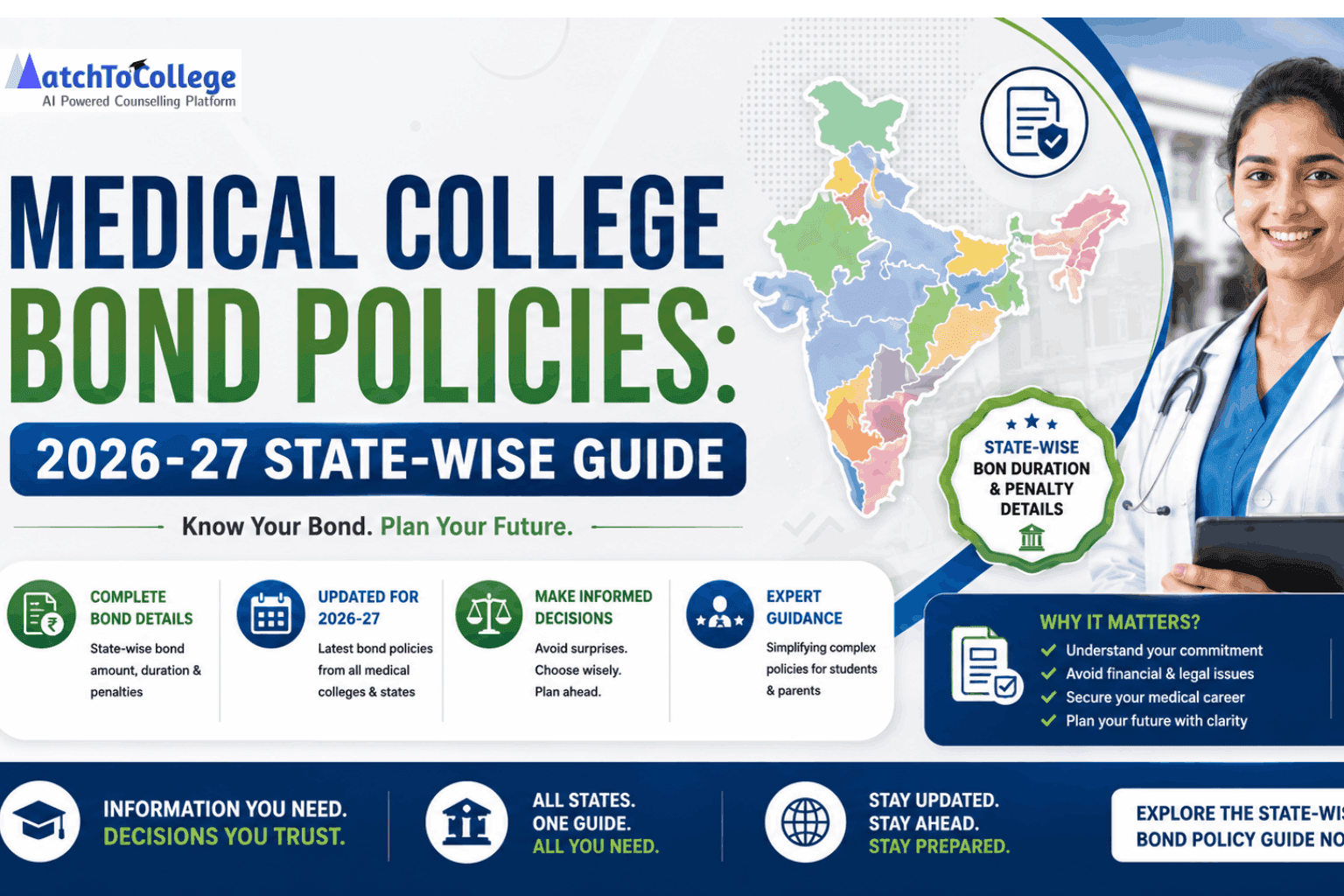
Securing a seat in an Indian government medical college is a monumental achievement, but for the academic session 2026-27, the journey doesn't end with an admission letter. One of the most critical factors that students and parents often overlook in the heat of NEET counseling is the 'Compulsory Rural Service Bond.' This legal agreement, mandated by state governments, requires medical graduates to serve in rural or underserved areas for a specific duration after completing their degree.
Failure to fulfill this obligation results in hefty financial penalties, often running into tens of lakhs or even crores. As we move into the 2026-27 cycle, several states have revised their policies to address the growing demand for healthcare professionals in rural sectors while balancing the career aspirations of young doctors.
The concept of the medical bond was originally introduced to bridge the gap between urban and rural healthcare delivery. However, the implementation varies drastically from one state to another. For instance, while some states like Delhi have virtually no service bond, others like Rajasthan and Haryana have historically implemented stringent policies that involve high bank guarantees.
Understanding these nuances is vital because a 'free' government seat can sometimes come with a hidden financial liability if the student decides to pursue post-graduation immediately or chooses a private-sector career path. At MatchToCollege, we leverage AI-driven insights to help students calculate the long-term ROI of their college choices, factoring in these bond durations and penalty structures.
In this guide, we provide an authoritative breakdown of the state-wise bond policies for 2026-27. We will explore the duration of service, the penalty amounts for both MBBS and PG courses, and the recent legal shifts initiated by the National Medical Commission (NMC) regarding 'seat leaving bonds.' Whether you are a high-ranking NEET aspirant or a parent planning the financial future of your child’s medical education, this comprehensive analysis is designed to provide the clarity you need to make an informed decision during the 2026 counseling process.
As the landscape of medical education in India becomes increasingly competitive, the bond policy is no longer just a footnote in a prospectus; it is a significant career determinant. For the 2026-27 session, many states are moving toward a more standardized approach, but regional disparities remain. By the end of this article, you will have a clear roadmap of which states offer the most student-friendly terms and which ones require a long-term commitment to public service. Let us dive deep into the regional specifics and financial implications of the 2026-27 medical bond policies.
The North Indian Landscape: Delhi, Rajasthan, and Haryana
The Northern states of India present a study in contrasts when it comes to medical bond policies for the 2026-27 session. Delhi remains the most sought-after destination for NEET toppers, primarily because institutions like MAMC, LHMC, and VMMC do not impose a compulsory rural service bond for MBBS graduates. This 'zero-bond' status allows students to transition immediately into PG preparation or private practice. However, for Post-Graduate (PG) courses in Delhi, there is a standard bond (usually around INR 10-20 Lakhs) to ensure that specialists serve the state’s healthcare system for at least a year.
In contrast, Rajasthan has historically maintained one of the most rigorous bond policies in the country. For the 2026-27 session, the state continues its policy of a 2-year service bond for MBBS graduates with a penalty of approximately INR 5 Lakhs. While the penalty amount is lower than some other states, the administrative enforcement is strict. Rajasthan also implements a 'Seat Leaving Bond' of INR 5 Lakhs, which applies if a student vacates their seat after the final round of counseling. This is designed to prevent seat wastage in high-demand government colleges.
Haryana recently witnessed significant policy shifts following student protests. For 2026-27, the state has refined its bond policy to include a mix of service and loan-based structures. The government facilitates education loans for students to cover the bond amount, which the state then repays if the student completes the mandated service in government hospitals. The total bond value can exceed INR 25-30 Lakhs, making it a critical financial consideration for aspirants. Understanding these variations is essential for North Indian candidates who must weigh the prestige of the college against the potential years of mandatory service or financial liability.
South Indian States: Karnataka, Tamil Nadu, and Kerala
South India, home to some of the nation's oldest and most prestigious medical institutions, has a deeply ingrained culture of rural service. Karnataka is a prime example, where the 'Compulsory Rural Service' is mandated by law. For the 2026-27 academic year, MBBS graduates from government colleges are required to serve one year in a rural setting. The penalty for non-compliance in Karnataka is significant, often reaching INR 15-25 Lakhs for MBBS and significantly higher for PG specialists. The state has been digitizing its bond tracking system to ensure that every graduate contributes to the public health system before moving into the private sector.
Tamil Nadu follows a similar path but with a heavy focus on Post-Graduate bonds. The state requires PG students to sign a bond for two years of service, with penalties that can go up to INR 50 Lakhs for super-specialty courses. For MBBS, the service duration is usually one year. Tamil Nadu’s policy is often praised for strengthening its primary healthcare centers (PHCs), but it requires students to be prepared for a delayed entry into specialized private practice. The 2026-27 guidelines suggest that the state may offer higher stipends during the bond period to make the transition more attractive for young doctors.
Kerala’s bond policy is tied closely to the availability of 'Bonded Residencies.' Students are expected to serve for one year. What makes Kerala unique is its high density of medical professionals, which sometimes leads to a shortage of rural vacancies. If the government fails to provide a posting within a certain timeframe, the bond is often waived. However, students must remain vigilant about the legal paperwork to ensure they are officially released from their obligation. In the 2026-27 session, Kerala is expected to maintain its penalty at approximately INR 10 Lakhs for MBBS and INR 50 Lakhs for PG candidates who skip their service requirements.
West and Central India: Maharashtra, Gujarat, and Madhya Pradesh
Maharashtra has one of the most structured bond systems in India, known for its 'Social Responsibility Service.' For the 2026-27 session, MBBS graduates must serve for one year. The penalty for failing to serve is INR 10 Lakhs. Maharashtra is particularly strict about the 'Seat Leaving Bond,' which can be as high as INR 10 Lakhs plus the reimbursement of the entire stipend received. This makes it incredibly risky for a student to join a college and then drop out for a better opportunity in the next NEET cycle. The state government has integrated bond status with the registration of medical licenses, meaning you cannot practice legally without a clearance certificate from the Directorate of Medical Education and Research (DMER).
In Gujarat, the bond policy for 2026-27 involves a mandatory service of one year or a penalty of INR 5 Lakhs. Gujarat also uses a 'Bank Guarantee' system for some categories, where students must provide a guarantee at the time of admission. This ensures that the state has immediate recourse if the student defaults. For PG students in Gujarat, the bond duration and penalty are scaled up, emphasizing the need for specialists in the tribal belts of the state. The Gujarat model is often cited as a balanced approach, providing a relatively lower financial barrier compared to Haryana while maintaining a steady supply of rural doctors.
Madhya Pradesh (MP) offers a 'Bond-Free' option only for those who do not avail of state scholarships. However, the majority of students who take advantage of the subsidized fee structure in government colleges are bound to serve for one year (for those from the general category) or longer for those under specific schemes like the 'Medhavi Chhatra Yojna.' The penalty in MP is around INR 10 Lakhs for MBBS. For the 2026-27 session, MP has simplified the process for doctors to choose their posting locations through an online merit-based system, which has slightly reduced the resistance toward rural service among graduates.
East and North-East: West Bengal, Odisha, and Assam
The Eastern states of India have been aggressively revising their bond policies to tackle the shortage of doctors in remote areas. West Bengal, for the 2026-27 academic session, mandates a one-year service bond for MBBS graduates with a penalty of INR 10 Lakhs. For PG candidates, the bond period is three years, and the penalty is a staggering INR 30 Lakhs. This long-term commitment is designed to stabilize the workforce in the state's expanding network of medical colleges. West Bengal also strictly enforces the seat-leaving penalty, which currently stands at INR 5 Lakhs for MBBS seats.
Odisha has implemented a '2-year service bond' for all candidates admitted to government medical colleges. For 2026-27, the penalty for defaulting on this service is set at double the amount of the stipend received during the course, or a fixed sum of INR 25 Lakhs for MBBS. The state is unique in that it offers significant 'In-Service' benefits for PG admissions to those who complete their rural stint, making the bond more of an investment than a penalty. This incentive-based model has seen a higher compliance rate among Odisha’s medical graduates.
In the North-East, Assam leads with a policy that requires five years of rural service or a penalty of INR 20 Lakhs for MBBS graduates. While five years is one of the longest durations in the country, the Assam government provides excellent benefits and weightage for PG entrance exams for those who serve. For the 2026-27 session, the state is considering a tiered system where service in 'extremely remote' areas would reduce the bond duration to three years. This flexibility is aimed at attracting talent to the most difficult terrains while ensuring that the healthcare needs of the state's diverse population are met effectively.
Share this Article
FAQFrequently Asked Questions
Q: What is the average bond penalty for MBBS in India for 2026-27?
The average penalty ranges from INR 5 Lakhs to INR 25 Lakhs, depending on the state. Some states like Haryana and West Bengal have higher penalties, while Delhi has no service bond for MBBS.
Q: Can I pursue PG without completing my MBBS rural bond?
Most states allow you to 'defer' or postpone the rural service if you secure a PG seat immediately. However, you will have to sign an undertaking to serve the combined bond period after your PG is completed.
Q: Is the 'Seat Leaving Bond' different from the 'Service Bond'?
Yes. The Seat Leaving Bond is a penalty for vacating a seat during the course, whereas the Service Bond is an agreement to work in rural areas after the degree is completed.
Q: Which state has the shortest medical bond duration?
States like Delhi, and sometimes Bihar or UP (under certain conditions), have shorter or no service bonds for MBBS. Most other states require 1 to 2 years of service.
Q: Does the National Medical Commission (NMC) regulate these bonds?
While the NMC provides guidelines and has recommended the abolition of 'seat leaving bonds,' the 'Service Bonds' are primarily governed by individual state health departments.
Top Colleges Covered in this Blog


Delhi Skill and Entrepreneurship University, founded in 2007 in South West, Delhi, is a premier academic institution dedicated to higher learning. Affiliated with Delhi Skill and Entrepreneurship University and adhering to statutory benchmarks established by University Grants Commission (UGC), the institution delivers specialized academic curricula centered on holistic multidisciplinary education, applied research, and professional competence. The institution maintains robust academic resources including digital lecture rooms, departmental resource centers, and central library, fostering an active student life and practical competencies. Dedicated to holistic student empowerment, the institution prepares ethical and career-ready professionals who contribute meaningfully to societal and industrial growth.
Total Fees
₹93K - ₹7.6L
Total Courses
15
Get More Info About Medical College Bond Policies
Recommended Reading

NEET Exam Tomorrow: Last-Minute Strategy to Maximize Your Score
NEET is tomorrow—here’s your complete last-day strategy covering revision, exam hall tips, and mistakes to avoid for maximum accuracy and performance.

GATE Previous Year Question Papers with Official Answer Keys (2007–2026) – Download PDF by Branch
Download official GATE previous year question papers with answer keys PDF from 2007 to 2026. Access branch-wise question papers for Computer Science (CS), Data Science (DA), Mechanical (ME), Electronics (EC), Electrical (EE), and Civil (CE) by IIT Madras.

NEET Exam Day Do’s and Don’ts (Must Read Before Leaving Home)
Students appearing for the National Eligibility cum Entrance Test (NEET) must follow strict exam day guidelines set by the National Testing Agency. From required documents and dress code to prohibited items, this guide covers the most important NEET exam day do’s and don’ts to help candidates avoid last-minute problems at the exam center.