

ATS 'White Font' Myth vs. LLM Resumes: 2026 Insights
Admission & Info Tools
Need Expert Assistance?
Our counselors can help you with fee structures, eligibility guidelines, and upcoming admission cutoffs instantly.
Direct Application Tools

The shift in resume evaluation
For years, many students and job seekers believed in a popular hack known as the "white font trick." The idea was simple: hide extra keywords in white text so they were invisible to humans but detectable by Applicant Tracking Systems (ATS), increasing the chances of passing the initial screening.
While this may have worked with older keyword-based systems, the world of admissions and recruitment has changed dramatically.
The End of Keyword Stuffing
Modern universities and employers are increasingly using advanced AI-powered systems that do much more than count keywords.
Today's AI can understand:
- Context
- Meaning
- Relevance
- Skills and experiences
- Semantic relationships between words
In other words, these systems evaluate what you actually mean—not just the words you include.
Old ATS vs. Modern AI Screening
| Traditional ATS | Modern AI & LLM-Based Systems |
| Keyword matching | Contextual understanding |
| Counts keywords | Evaluates meaning and relevance |
| Easily manipulated | Detects unnatural keyword stuffing |
| Limited analysis | Understands skills and experiences |
| Focused on exact words | Focused on intent and context |
Why the White Font Trick Is Obsolete
Hidden keywords may:
- Provide no advantage.
- Make your application appear unnatural.
- Reduce credibility.
- Be detected by modern AI systems.
- Hurt your chances rather than improve them.
Authenticity matters far more than trying to game the system.
What Modern AI Actually Looks For
| Factor | Why It Matters |
| Relevant Skills | Demonstrates your qualifications |
| Real Experience | Shows practical knowledge and achievements |
| Clear Language | Helps AI understand your profile |
| Project Work | Highlights hands-on learning |
| Achievements | Provides measurable impact |
| Context | Connects your experiences to the role or program |
How to Optimize Your Resume the Right Way
| Do's ✅ | Don'ts ❌ |
| Use keywords naturally. | Stuff keywords unnaturally. |
| Highlight projects and achievements. | Hide text or use white fonts. |
| Quantify your impact whenever possible. | Copy descriptions word for word. |
| Tailor your resume to the specific role or program. | Focus only on buzzwords. |
| Use clear headings and a simple, readable format. | Rely on outdated tricks or hacks. |
Modern AI doesn't reward tricks—it rewards relevance.
A strong application should tell a coherent story about:
- Your skills
- Your experiences
- Your achievements
- Your goals
- Your potential
The better your profile reflects these elements, the more likely it is to resonate with both AI systems and human reviewers.
The era of gaming the system with hidden keywords is over.
As AI-powered screening becomes the norm, success will depend on genuine experiences, relevant skills, and clear storytelling—not outdated tricks.
MatchToCollege helps students create authentic, future-ready profiles that resonate with both advanced AI systems and admissions teams.
Because the best applications aren't built on hacks—they're built on real potential.
The 'White Font' Myth: A Relic of Outdated ATS
For a generation of applicants, the 'white font' trick seemed like a clever hack. The idea was simple: add a host of industry-specific keywords, program names, or skill sets to your resume, make them the same color as the background (usually white), and voilà – the ATS would pick them up, boosting your resume's score without cluttering the visible text. This myth gained traction because early Applicant Tracking Systems were indeed quite basic. They functioned primarily as keyword counters, tallying instances of predefined terms. If your resume hit a certain keyword density threshold, it advanced. These systems lacked the sophistication to understand context, identify duplicate text, or even differentiate between visible and hidden content beyond basic formatting. The promise of an easy shortcut was too tempting to resist, leading many to believe they could bypass the human element by simply stuffing their digital applications. However, as technology progresses, so does the intelligence of these screening tools, rendering such simplistic tricks not just ineffective, but potentially detrimental.
Beyond Keywords: How 2026 LLM-Based Resumes Spot the Tricks
Welcome to the era of Artificial Intelligence that truly understands. Modern Applicant Tracking Systems, especially those powered by Large Language Models (LLMs), represent a monumental leap from their keyword-counting predecessors. These sophisticated algorithms, much like the AI behind MatchToCollege's personalized recommendations, are trained on vast datasets of text, enabling them to grasp nuances, identify relationships between concepts, and interpret meaning within a given context. An LLM-based parser doesn't just see "project management" as a keyword; it understands what project management entails. It can identify if your experience genuinely reflects those responsibilities, even if you use different phrasing.
More importantly, these systems are designed to detect anomalies. They can easily distinguish between genuinely integrated skills and experience descriptions versus a block of hidden, irrelevant terms. They recognize patterns of keyword stuffing, even in disguised forms, and can flag such attempts as deceptive or irrelevant, effectively discarding them. Trying to game an LLM is akin to trying to trick a human who possesses an encyclopedic knowledge of your field – it's incredibly difficult and rarely fruitful. The future of applications demands authenticity and contextual relevance, not clever but transparent deceptions.
MatchToCollege's Guide: Crafting Resumes for AI & Human Success
With the 'white font' myth firmly debunked, how do you truly optimize your resume for both discerning AI and human readers? The answer lies in authenticity, clarity, and strategic relevance.
- Focus on Genuine Content: Forget tricks. Highlight your real skills, achievements, and experiences. LLMs are looking for substance that aligns with the program or role you're applying for.
- Contextual Keywords: Integrate relevant keywords naturally within your descriptions. Instead of listing "Python" multiple times, describe projects where you applied Python to solve specific problems. Use strong action verbs and quantifiable results that demonstrate proficiency.
- Clear, Logical Structure: A well-organized resume is easier for both AI and humans to parse. Use standard headings (Education, Experience, Skills, Awards) and maintain consistent, professional formatting.
- Proofread Meticulously: AI can detect grammatical errors and typos, which negatively impact your professional image and signal a lack of attention to detail. A clean, error-free resume is paramount.
- Tailor, Don't Stuff: Customize your resume for each application. Research the specific program or role, identify key competencies and required experiences, and then highlight how your unique qualifications directly align. MatchToCollege's AI-powered platform can help you identify these crucial alignment points, making the tailoring process more effective and less guesswork.
In the age of intelligent AI, your resume should be a compelling, truthful narrative of your qualifications, not a puzzle for a computer to solve.
Share this Article
FAQFrequently Asked Questions
Q: Is the 'white font' trick still effective for getting past Applicant Tracking Systems (ATS)?
No, the 'white font' trick is completely ineffective with modern Applicant Tracking Systems. While it might have fooled rudimentary keyword counters in the past, today's LLM-based (Large Language Model) ATS can easily detect and disregard hidden text, understanding that it's an attempt at keyword stuffing rather than genuine content. Such tactics can even flag your application negatively, harming your chances.
Q: How do LLM-based resume parsing systems differ from older ATS?
Older ATS primarily functioned as simple keyword counters, matching specific terms. LLM-based systems, like those becoming standard by 2026, use advanced Artificial Intelligence and Natural Language Processing to understand the *context*, *meaning*, and *relevance* of the content in your resume. They can interpret complex phrases, identify skills through descriptive experiences, and discern genuine qualifications from mere keyword lists, making them far more sophisticated and harder to 'trick.'
Q: What's the best way to optimize my resume for modern AI and human reviewers?
Focus on creating a resume that is clear, authentic, and rich in genuine, relevant content. Use strong action verbs, quantify your achievements where possible, and integrate keywords naturally within the descriptions of your experiences and skills. Tailor your resume for each specific application, highlighting how your qualifications directly align with the program or job requirements. Tools like MatchToCollege can assist in identifying these crucial alignment points, ensuring your resume stands out for its true value.
Get More Info About ATS 'White Font' Myth vs. LLM Resumes
Recommended Reading
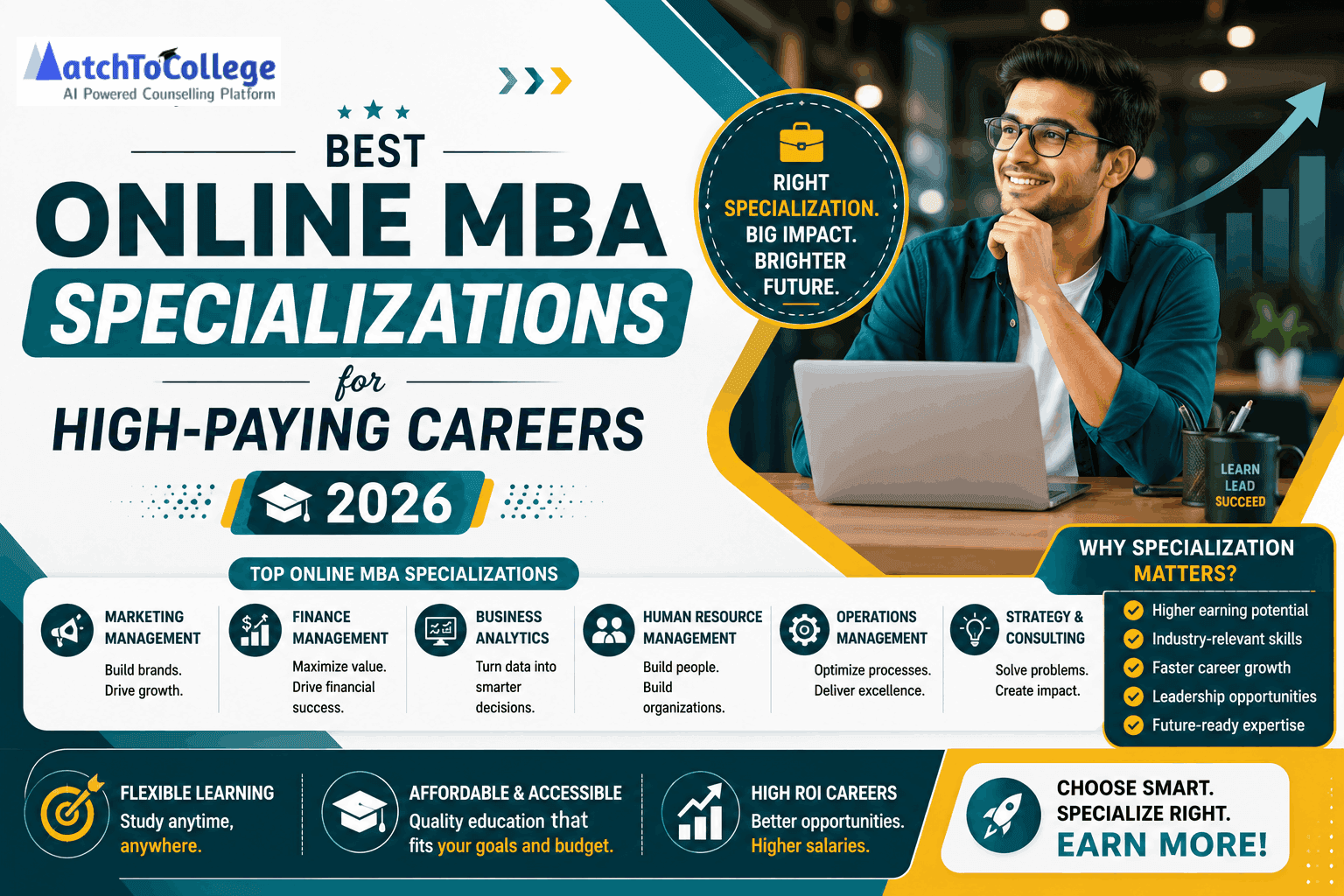
Best Online MBA Specializations for High-Paying Careers 2026
Discover the most lucrative online MBA specializations for 2026-27. Compare ROI, career growth, and use our AI tools to find your perfect management path.

Top Career Opportunities After an Online MBA in 2026-27
Discover high-paying career paths and roles after an online MBA in 2026-27. Explore salary trends, ROI, and tools to navigate your future professional success.

Tax Deductions on Higher Education: 2026-27 India Guide
Maximize your savings with our guide on tax deductions for higher education fees in India for FY 2026-27. Learn about Section 80C, 80E, and upskilling benefits.