

AIQ vs State Quota: Best NEET 2026 Counseling Strategy
Admission & Info Tools
Need Expert Assistance?
Our counselors can help you with fee structures, eligibility guidelines, and upcoming admission cutoffs instantly.
Direct Application Tools

The journey to wearing a white coat and stethoscope is a grueling marathon, but the most critical turn in that race isn't the exam itself—it's the counseling process. For students appearing for the National Eligibility cum Entrance Test in 2026, understanding the bifurcation of seats is paramount. The Indian medical education system divides seats in government medical colleges into two primary categories: the All India Quota (AIQ) and the State Quota.
Choosing between these isn't just about where you want to study; it's about playing a strategic game where your rank, domicile status, and category can significantly shift the odds in your favor. With the increasing competition, relying on manual data is no longer enough. Many smart aspirants are now turning to AI-powered tools like the Predict Your NEET 2026 Rank Instantly tool to understand where they stand long before the official merit list is out.
As we approach the 2026 admission cycle, the seat matrix is expected to evolve with more medical colleges being added across various states.
However, the core structure remains the same: 15% of all seats in government medical colleges are reserved for the All India Quota, managed by the Medical Counseling Committee (MCC), while the remaining 85% are reserved for candidates belonging to that specific state. This distinction creates a complex dynamic. For instance, a candidate with a high rank might find it easier to get a seat in a prestigious college in another state through AIQ, while a candidate with a slightly lower rank might find their best chance within their home state's 85% reservation.
To navigate this, using a NEET College Predictor becomes an essential part of the preparation toolkit, allowing you to simulate different scenarios based on previous year trends and current seat updates.
MatchToCollege aims to bridge the gap between confusion and clarity. Whether you are aiming for a top-tier AIIMS or a reputable state-run medical college, your strategy must be data-driven.
This blog post will deep-dive into the technicalities of both quotas, comparing cut-offs, reservation benefits, and the impact of domicile rules. We will also explore how you can use tools like the NEET OMR Score Calculator to verify your results the moment you step out of the exam hall, ensuring you have the most accurate data to begin your counseling research. In the competitive landscape of 2026, every mark counts, and every decision in the counseling portal can change your career trajectory.
Understanding the 15% All India Quota (AIQ): The Gateway to the Nation
The All India Quota was introduced by the Supreme Court of India to ensure that students from any state have the opportunity to study in the best medical colleges across the country, regardless of their domicile. Under AIQ, 15% of the seats in every government medical college (MBBS and BDS) are pooled together for a national-level counseling process.
This pool also includes 100% of seats in AIIMS, JIPMER, Central Universities (like DU, AMU, BHU), and Deemed Universities. The Medical Counseling Committee (MCC) conducts this process in four main rounds: Round 1, Round 2, Mop-up Round, and the Stray Vacancy Round. The beauty of AIQ is its transparency and the lack of domicile restrictions. If you are a resident of Karnataka but dream of studying at Maulana Azad Medical College in Delhi, AIQ is your only path.
However, AIQ is notoriously competitive. Since it opens the doors for students from all 28 states and 8 Union Territories, the cut-offs are generally much higher than state quotas for the same colleges. In 2026, we expect this trend to sharpen as the number of aspirants continues to cross the 2.5 million mark. To succeed here, you need to be in the top bracket of scorers. Using a NEET Result Checker can help you quickly compare your performance against the national average.
Furthermore, students must be aware that AIQ counseling happens online and requires meticulous choice filling. A single error in ranking your preferences can result in losing a seat that your rank actually deserved. This is why MatchToCollege emphasizes the use of an AI-driven NEET College Predictor, which analyzes thousands of data points to suggest the best possible colleges you can realistically get through the All India Quota.
It is also important to note the financial implications of AIQ. While government colleges remain affordable, the AIQ counseling also handles Deemed Universities where fees can be significantly higher. If you find yourself looking at these options, it is wise to start financial planning early. Our Education Loan EMI Calculator can help you and your parents understand the long-term feasibility of choosing a high-fee institution if a government seat via AIQ or State Quota isn't available.
The 85% State Quota: Home Advantage and Domicile Rules
The 85% State Quota is often the most viable path for the majority of medical aspirants. Each state conducts its own counseling for the seats remaining after the 15% AIQ contribution. These seats are reserved specifically for students who meet the state's domicile criteria—usually defined by where you finished your 10th and 12th schooling or where your parents have lived for a certain number of years.
This quota provides a significant safety net. Because the competition is limited to students within that specific state, the cut-offs for state quota seats are almost always lower than AIQ seats in the same institutions. This is particularly beneficial in states with a high number of medical colleges, such as Maharashtra, Tamil Nadu, and Karnataka.
However, the challenge with State Quota is the variety in rules. Every state authority (like the CET Cell in Maharashtra or KEA in Karnataka) has its own registration timeline, document verification process, and reservation policies (SC, ST, OBC, EWS, and various state-specific sub-categories). Navigating these can be a bureaucratic nightmare. To streamline your search, you can explore the domestic colleges listing on our platform, which categorizes institutions by state and quota types.
This helps you identify which colleges within your state fit your rank and category profile. For those who feel their NEET score might not be sufficient for a government seat even within the state quota, exploring private colleges through the same state counseling is an option, though the fee structure will differ.
In 2026, domicile verification is expected to become even stricter to prevent 'seat blocking' where students try to claim residency in multiple states. It is crucial to have your documents in order months before the exam. If the state quota results aren't looking promising, many students consider the MBBS abroad route as a high-quality alternative. Using tools like the Predict Your NEET 2026 Rank Instantly tool allows you to make this pivot early, ensuring you don't miss out on international admission deadlines while waiting for state counseling rounds that might not yield a result.
AIQ vs. State Quota: A Direct Comparison for 2026
When deciding whether to focus your energy on AIQ or State Quota, several factors come into play. The first is 'Cut-off Variance.' In high-demand states like Delhi or Rajasthan, the state quota cut-offs can actually be higher than the AIQ cut-offs for other states. In contrast, in states like West Bengal or Himachal Pradesh, the state quota is significantly easier to clear.
This 'relative difficulty' is something students must calculate using a NEET College Predictor specifically tailored for both national and state trends. Secondly, consider the 'College Quality.' If your rank allows you a top-tier college in your state via state quota versus a mid-tier college in a distant state via AIQ, the state quota is usually the better choice due to proximity and local language advantages in clinical practice.
The third factor is the 'Bond Policy.' Many states require medical students to serve in rural areas for 1 to 5 years after graduation or pay a hefty penalty. AIQ students are subject to the bond policy of the state where the college is located, but these rules are sometimes different for AIQ vs. State candidates. Before locking in your choices, checking these details is vital. If you are unsure if a medical career with these commitments is right for you, our Are You on the Right Path to Your Dream Career? tool can help you evaluate your interests against the realities of a doctor's life. Furthermore, for students who may have appeared for multiple exams, we provide tools like the Predict Your JEE Main 2026 Rank Instantly tool, as many students keep engineering as a backup.
Lastly, the timing of counseling is a factor. Usually, AIQ Round 1 happens first, followed by State Round 1. This sequence allows students to gauge their chances. If you get a seat in AIQ Round 1, you can still participate in State Round 1 to see if you get a better college locally. Understanding these 'upgradation rules' is key to a successful strategy. To keep track of your academic standing across various metrics, our CGPA to Percentage Calculator and other conversion tools ensure your application data is always accurate for various state forms that might require different formats.
Strategic Choice-Filling and AI Intervention
Choice-filling is the most technical part of the NEET 2026 journey. Many students with excellent ranks end up in mediocre colleges because they didn't list their preferences correctly. In AIQ counseling, you have hundreds of options, and the order in which you list them determines your future.
A common mistake is listing only the 'dream' colleges and leaving out the 'realistic' ones, leading to no allotment in early rounds. Conversely, listing a college you don't actually want to join can lead to forfeiture of your security deposit if you are allotted a seat and don't report. Using the NEET OMR Score Calculator early on gives you a realistic score to start building your choice list well before the counseling portal opens.
This is where MatchToCollege’s AI counseling comes into play. Our platform doesn't just give you a list; it provides a 'Smart Choice Preference' based on your rank, category, and desired location. It compares the AIQ and State Quota possibilities side-by-side. For instance, if you have a rank of 15,000, our NEET College Predictor might show that you have a 10% chance in AIQ for a top college but a 90% chance in your State Quota for a similarly ranked institution.
This data allows you to prioritize the state counseling more effectively. Additionally, for students who are looking at the broader picture of their education, we offer tools like the Will You Actually Finish Your Online Degree? predictor for those considering allied health sciences online.
Remember that the 2026 session will likely see tighter integration between the various counseling rounds to prevent seat wastage. This means you must be decisive. By using the NEET Result Checker and staying updated through our platform, you ensure that you are never operating on outdated information. Whether it is calculating the ROI of a private medical seat via our Calculate Your University ROI Compare tool or determining if you need an education loan, being prepared is the only way to beat the competition. The difference between a doctor and an aspirant often boils down to these final strategic choices in the counseling room.
Share this Article
FAQFrequently Asked Questions
Q: Can I participate in both AIQ and State Quota counseling?
Yes, candidates are encouraged to participate in both. Usually, AIQ rounds happen first, and depending on whether you are allotted a seat or not, you can proceed to your state's 85% quota counseling. However, once you join a seat in AIQ Round 2 or beyond, you are typically barred from state counseling to prevent seat blocking.
Q: Which quota has lower cut-offs for NEET 2026?
Generally, the State Quota (85%) has lower cut-offs compared to the All India Quota (15%) because the competition is restricted to students from that specific state. However, in states like Delhi, Kerala, and Rajasthan, the competition is so high that state cut-offs can sometimes rival or exceed AIQ cut-offs.
Q: How do I know my domicile for the 85% State Quota?
Domicile criteria vary by state. Common requirements include having studied in the state for 5-10 years, being a permanent resident, or having parents who are state government employees. You should check the specific information brochure of your state's counseling authority.
Q: Are AIIMS and JIPMER seats part of AIQ?
Yes, 100% of seats in AIIMS and JIPMER are filled through the All India Quota counseling conducted by the MCC. There is no state quota for these national institutes, although some may have internal institutional preferences.
Q: What tools can help me decide between AIQ and State Quota?
Tools like the NEET College Predictor and NEET Rank Predictor on MatchToCollege are invaluable. They allow you to input your score and see which colleges you are likely to get under both AIQ and State Quota based on historical data.
Top Colleges Covered in this Blog
All India Institute Of Medical Sciences
All India Institute Of Medical Sciences
The All India Institutes of Medical Sciences (AIIMS) is a group of autonomous government public medical universities of higher education under the jurisdiction of Ministry of Health and Family Welfare, Government of India. These institutes have been declared by an Act of Parliament as Institutes of National Importance. AIIMS New Delhi, the forerunner institute, was established in 1956. Since then, 24 more institutes were announced. As of January 2023, twenty institutes are operating and four more are expected to become operational until 2025. Proposals were made for six more AIIMS under the leadership of Narendra Modi. It is considered as pioneer health institution of Asia.
Total Fees
₹1K - ₹8K
Total Courses
17


Maulana Azad Medical College
Maulana Azad Medical College
The foundation stone of MAMC was laid on Saturday, 24th October 1959, by Union Home Minister Pandit Govind Ballabh Pant. The event was reported by all major newspapers. Here is the excerpt from the Hindustan Times dated October 25th, 1959. Laying the foundation stone of the new building of the Maulana Azad Medical College on a 30-acre land, Pandit Pant paid a great tribute to Maulana Azad. The Home Minister said Maulana Azad was one of the greatest patriots of the country who combined statesmanship with profound scholarship. His memories would inspire his countrymen for his long devotion to the service of humanity.
Total Fees
₹720 - ₹39K
Total Courses
5
Get More Info About AIQ vs State Quota
Recommended Reading

NEET 2026 Counseling: Vital Deadlines & Verification Guide
Master the NEET 2026 counseling process. Learn about document verification, college reporting deadlines, and essential paperwork to secure your medical seat.

NEET 2026 Counseling: Freeze, Float, & Slide Rules Explained
Master the NEET 2026 counseling process with our guide on Freeze, Float, and Slide options. Learn exit policies, seat allotment rules, and security deposits.
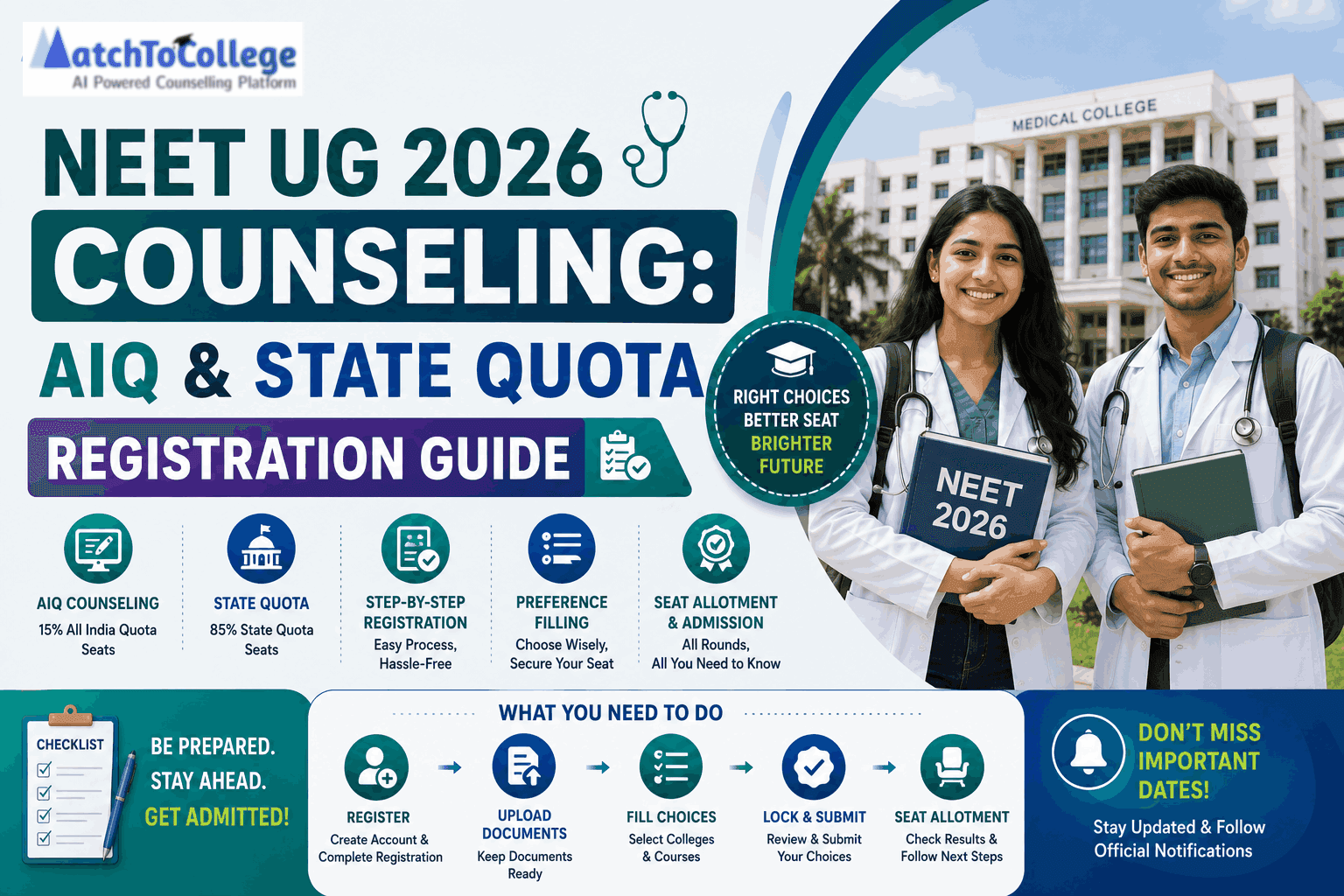
NEET UG 2026 Counseling: AIQ & State Quota Registration Guide
Master the NEET UG 2026 counseling process. Our step-by-step guide covers AIQ, State Quota registration, choice filling strategies, and essential AI tools.