

5-Year vs 6-Year MBBS Abroad: NMC Norms 2026-27 Guide
Admission & Info Tools
Need Expert Assistance?
Our counselors can help you with fee structures, eligibility guidelines, and upcoming admission cutoffs instantly.
Direct Application Tools
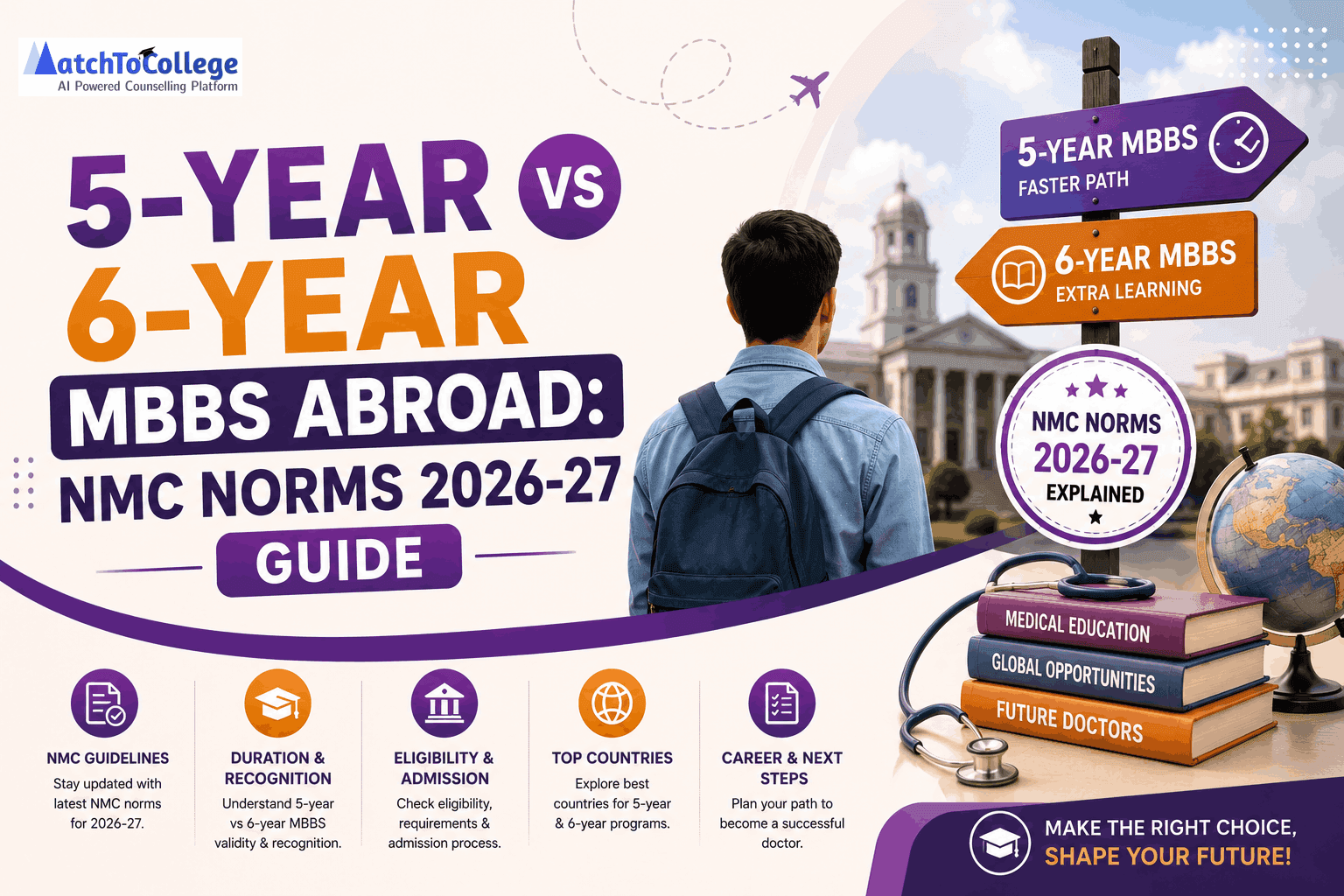
Deciding to pursue a medical degree outside India is a life-altering decision that requires meticulous planning, especially with the evolving landscape of the National Medical Commission (NMC) regulations. As we approach the 2026-27 academic session, the debate between 5-year and 6-year MBBS programs has become more than just a matter of duration; it is now a matter of legality and career survival.
For thousands of Indian students who do not secure a seat in government colleges via NEET, looking abroad is the most viable path. However, the path is fraught with regulatory hurdles that could prevent you from ever practicing in India if not handled correctly. To help you navigate this, MatchToCollege offers advanced tools like the NEET College Predictor and the NEET 2026 Rank Predictor to ensure your foundation is solid.
Historically, countries like Kyrgyzstan, Kazakhstan, and the Philippines offered 5-year programs, while Russia, Georgia, and many European nations offered 6-year programs. The difference often lay in how the internship was structured. However, the NMC Foreign Medical Graduate Licensure (FMGL) Regulations of 2021 changed everything. These rules stipulate that any medical qualification obtained abroad must meet specific criteria to be recognized in India.
Specifically, the course must be at least 54 months of theoretical study plus 12 months of internship in the same institution. This total duration of 5.5 to 6 years has effectively made the traditional 5-year 'theory-only' programs obsolete for Indian students wishing to return home. Before you commit, it is essential to use a NEET OMR Score Calculator to gauge your performance and understand your standing.
As we look toward 2026-27, the implementation of the National Exit Test (NExT) further complicates the choice. The NExT will be mandatory for all foreign medical graduates (FMGs) and Indian medical graduates alike to obtain a license to practice. If your 5-year program does not strictly adhere to the 54+12 months rule, you may be barred from sitting for the NExT exam. This makes the 6-year program, which inherently accommodates the internship within its curriculum, a much safer bet.
At MatchToCollege, we emphasize using data-driven insights. Our Career Pathway Matcher can help you decide if a specific country's curriculum aligns with your long-term goals of practicing in India or abroad. Furthermore, understanding the financial implications of an extra year is vital, which is why we recommend checking our Education Loan EMI Calculator to plan your budget effectively.
Understanding NMC FMGL 2021 Regulations for 2026-27
The core of the 5-year vs 6-year debate lies in the National Medical Commission's Foreign Medical Graduate Licensure Regulations, 2021. These regulations were introduced to standardize the quality of medical education Indian students receive abroad.
For any student enrolling in an MBBS program abroad for the 2026-27 session, the following rules are non-negotiable: the entire course duration must be at least 54 months of theoretical and clinical instruction, followed by an additional 12 months of mandatory internship in the same medical college where the degree was pursued. Furthermore, the medium of instruction must be English, and the curriculum must align with that of the MBBS program in India. Use our NEET Result Checker to ensure your scores meet the eligibility criteria for these international institutions.
Many 5-year programs in the past were structured as 4 years of study and 1 year of internship. Under the new 54-month rule, such programs fall short by 6 months. If a student completes such a program, they might find themselves ineligible to register with the State Medical Councils in India. This is why many universities in Kyrgyzstan and Kazakhstan have recently updated their curricula to extend to 5.5 or 6 years to remain compliant with NMC norms. It is crucial to verify if the '5-year program' you are being offered is actually a 5.5-year program that meets the 54-month academic requirement. You can explore compliant universities through our MBBS Abroad listings.
Moreover, the NMC requires that the student must be registered with the respective professional regulatory body of the country where the degree is obtained. This means you must be eligible to practice medicine in that country before you can apply for the NExT in India. Many 6-year programs in Russia and Eastern Europe have integrated this licensing process into their final year, providing a smoother transition. Before making a final decision, use the Online Degree Passing Predictor (adapted for medical rigor) to assess the difficulty levels of these extended programs and ensure you are prepared for the academic load.
The 5-Year MBBS Dilemma: Risks and Reality
While 5-year programs often seem attractive due to lower tuition fees and a faster path to starting a career, they carry significant risks under the current and upcoming NMC norms for 2026-27. The primary risk is the 'gap' in clinical hours. Many shorter programs prioritize classroom learning over hands-on clinical rotations, which are the backbone of the 54-month requirement. If the NMC audits your transcripts and finds that your clinical hours do not meet Indian standards, your degree could be declared invalid for practice in India. This is where the NEET College Predictor becomes useful for domestic alternatives if the abroad risks seem too high.
Furthermore, students in 5-year programs often face challenges when applying for the mandatory 12-month internship in the host country. Some countries allow the degree but do not permit foreign students to perform internships in local hospitals, or they may require a separate entrance exam in the local language (e.g., the Philippines' requirement of the NMAT and local residency rules). If you cannot complete the internship in the same college, you violate the 'same institution' clause of the NMC FMGL 2021. To visualize your potential financial journey, use the Million to Crore Calculator to understand the total investment needed for these programs including hidden costs.
Lastly, the 5-year duration often puts immense pressure on students to clear the NExT exam. The NExT is expected to be a highly competitive exam, and students from 6-year programs generally have more clinical exposure, which is vital for the NExT Step 1 (theory) and Step 2 (practical/clinical). If you are considering a 5-year path to save money, check our ROI Calculator to see if the risk of potentially being unable to practice in India outweighs the initial savings. Most experts now recommend 6-year programs as the 'gold standard' for FMG compliance.
The 6-Year MBBS Advantage: Compliance and Quality
A 6-year MBBS program, typical of Russia, Georgia, and Western European nations, naturally fits the NMC's 54+12 month requirement. These programs are usually structured as 5 years of academic and clinical study followed by a 1-year internship. This structure ensures that students not only meet the minimum 54-month theory requirement but often exceed it, providing a more robust medical education. When you use the Career Pathway Matcher, you will find that 6-year programs consistently rank higher for students aiming for long-term clinical excellence.
One of the biggest advantages of 6-year programs is the depth of clinical rotations. In countries like Georgia or Poland, the final years are almost entirely spent in hospital settings, rotating through different departments. This hands-on experience is exactly what the NExT exam aims to test. By the time a student from a 6-year program reaches the licensing stage in India, they have already spent two years in clinical settings, making them much more prepared than their 5-year counterparts. To help manage the transition, students can use the CGPA to Percentage Calculator to align their international grades with Indian standards during documentation.
Additionally, 6-year programs offer more time for language acquisition. While the degree is in English, interacting with patients in local hospitals requires a basic understanding of the local tongue. The extra year provides a buffer to become proficient, which is often a requirement for the mandatory host-country registration mandated by the NMC. For those worried about the age factor of studying for an extra year, our Age Calculator can help you plan your career timeline effectively, showing that a 6-year degree still allows for a long and fruitful medical career starting in your mid-20s.
Share this Article
FAQFrequently Asked Questions
Q: Is a 5-year MBBS degree abroad valid in India according to NMC?
A 5-year program is only valid if it includes 54 months of theoretical study and 12 months of internship at the same institution, totaling 5.5 to 6 years. Most traditional 5-year programs do not meet this 54-month academic requirement and are thus risky.
Q: What is the NMC 54-month rule for MBBS abroad?
The NMC FMGL Regulations 2021 state that the course of study for MBBS abroad must be at least 54 months of academic study plus 1 year of internship in the same college.
Q: Can I do my internship in India after completing MBBS abroad?
No, per the 2021 norms, you must complete a 12-month internship in the same foreign medical college where you studied. After returning to India and passing the NExT/FMGE, you must complete an additional 12-month internship (CRMI) in India.
Q: Which countries offer NMC-compliant 6-year MBBS programs?
Russia, Georgia, Poland, Hungary, and Armenia are popular destinations that offer 6-year programs that generally comply with the 54+12 month NMC regulation.
Q: How can I check if my NEET score is enough for MBBS abroad?
You can use the MatchToCollege NEET College Predictor and NEET Rank Predictor to see if you qualify. You only need to 'Qualify' NEET (get the 50th percentile for General) to be eligible for MBBS abroad.
Get More Info About 5-Year vs 6-Year MBBS Abroad
Recommended Reading

NEET Exam Tomorrow: Last-Minute Strategy to Maximize Your Score
NEET is tomorrow—here’s your complete last-day strategy covering revision, exam hall tips, and mistakes to avoid for maximum accuracy and performance.
GATE Previous Year Question Papers with Official Answer Keys (2007–2026) – Download PDF by Branch
Download official GATE previous year question papers with answer keys PDF from 2007 to 2026. Access branch-wise question papers for Computer Science (CS), Data Science (DA), Mechanical (ME), Electronics (EC), Electrical (EE), and Civil (CE) by IIT Madras.

NEET Exam Day Do’s and Don’ts (Must Read Before Leaving Home)
Students appearing for the National Eligibility cum Entrance Test (NEET) must follow strict exam day guidelines set by the National Testing Agency. From required documents and dress code to prohibited items, this guide covers the most important NEET exam day do’s and don’ts to help candidates avoid last-minute problems at the exam center.